
How Diamond Bar Residents Are Found
Diamond Bar is an incorporated city, but it is not a separate county records jurisdiction. City Hall keeps municipal material such as permits, business-license reports, agendas, and code files. Los Angeles County keeps deeds, vital records, voter registration, property assessment, and court records. That split shapes a useful residents directory. An owner clue comes from the Assessor or the city parcel viewer. A recorded transfer comes from the Los Angeles County Registrar-Recorder/County Clerk. A court party search can confirm a case trail, while a library volume may place a household in an earlier year. Each record answers a narrower question than the word resident suggests.
A name search and an address search should not be treated as the same task. The County Assessor portal begins with an AIN or address and does not advertise a public owner-name mode. The city GIS viewer adds parcel boundaries, zoning, and ownership information. The voter tool is a private self-verification form, not a public street roll. For an older household, the Los Angeles Public Library's OCR shelf and the County Californiana Collection may help, but their geographic coverage must be checked because Diamond Bar grew from ranch land and a master-planned community after the classic directory era.
- Start with the standardized street address in the Los Angeles County Assessor Portal or the city Property Parcel Viewer. Save the AIN, legal description, map result, and any transfer clue.
- Use the Diamond Bar permit archive and municipal records library to test the same street and house number. An applicant or contractor is evidence of a project, not proof of residence.
- Use the Los Angeles County voter verification service only for a person's own matching check. It requires last name, birthdate, residence house number, and ZIP.
- Carry a known party name and recording year to the RR/CC index in Norwalk. The deed index is arranged by grantor or grantee and year, not by address on the public web.
- For past households, compare reverse-directory entries, census schedules, permits, obituaries, and probate. If a city file is missing, submit a narrow request through the Diamond Bar public-records route or ask a library reference desk.
That sequence keeps the Diamond Bar residents directory grounded in custodial records. It also stops a single same-name hit from becoming a claim about the wrong person.
Where Diamond Bar Keeps Resident Records
Three offices anchor the local records map. The City Clerk handles city transparency and directs requests for municipal files. The County Assessor supplies parcel facts through an address or AIN search. The Registrar-Recorder/County Clerk holds recorded land documents and county vital records, with a crucial in-person index rule. The Diamond Bar City Clerk also links to election and meeting material, but the master voter file remains a county function.
Los Angeles County RR/CC
12400 Imperial Highway
Norwalk, CA 90650
(800) 201-8999
Diamond Bar City Clerk
21810 Copley Drive
Diamond Bar, CA 91765
(909) 839-7010
Los Angeles County Assessor
Address and AIN search
Map and legal-search modes
Public portal
Physical access matters. RR/CC real-estate records are reviewed at the Norwalk headquarters, while city permit and planning help is available through Building & Safety and Planning. A records request does not move a county deed into a city file. It asks the proper department to locate a responsive municipal record under the California Public Records Act, Government Code sections 7920.000 and following.
The Diamond Bar Online Records Library is the best first stop for city material. It has a free search box and category browse for permits, business-license reports, council documents, commission records, and prior requests.
The city library is shown here through the public repository landing page. The category structure is useful because a street search can move from a permit to a council packet without treating either as a household list.
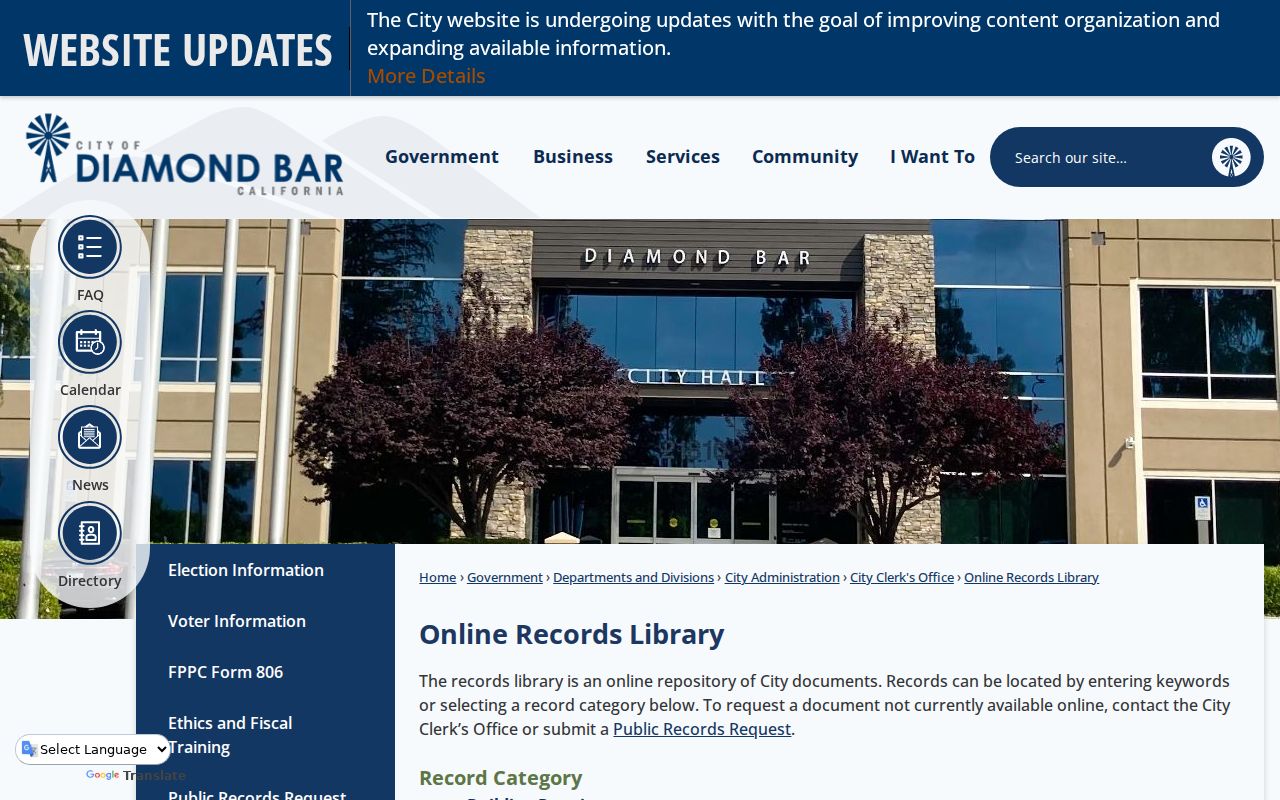
The online library adds city context to the county rolls, but it does not replace the RR/CC, Assessor, or Superior Court custodians.
Diamond Bar Resident Parcel Search
The Los Angeles County Assessor is the cleanest way to anchor a Diamond Bar address. Its public interface offers Basic Search, Legal Search, and Map Search. The main route accepts an AIN or standardized address. An AIN means Assessor Identification Number, a parcel identifier that is commonly displayed with hyphens. The result can tie a situs address to legal description, use, assessed land and improvement values, building facts, map geometry, and roll-year information.
| Portal control | Type | Required | What it does |
|---|---|---|---|
| Basic Search | Tab or button | No | Starts a current property lookup |
| Legal Search | Tab or button | No | Uses the legal-description route |
| Search by AIN or Address | Text or autocomplete | Yes | Accepts an AIN or standardized situs address |
| Map Search | Interactive map | No | Pans, zooms, and selects a parcel |
| Results and map | Linked panel | After search | Shows parcel facts and the effective-record date |
The assessor screen is an address tool, not a complete resident directory. Owner names and mailing details are access-sensitive, and a mailing address can differ from the physical parcel. The city Property Parcel Viewer can be compared with the county result for boundary, zoning, and ownership information. Save both the situs address and legal description before moving to deeds.
The image source is the official Assessor Portal. Its AIN-or-address design explains why an address-first search is more reliable than guessing a person name.
A parcel result narrows the record trail. It does not establish that the owner occupies the home or identify every person who uses it.
The Offline Norwalk Deed Index
Los Angeles County's real-estate index is the most important local quirk in the Diamond Bar residents directory. The full grantor-grantee index is not exposed on the internet. County Counsel cited the risk that an online index could reveal protected officials' home addresses, and the office keeps the index at Norwalk instead. Records from 1851 through 1957 are reviewed downstairs. Records from 1958 to the present are on the second floor. The copy-order page also says the holdings begin in 1850, so the small date conflict should be checked with RR/CC staff before a historical search.
Bring a party surname, first name or initial, role as grantor or grantee, and recording year. The counter index may supply a document number, recording date, title, and older book and page. There is no official address search and no telephone index search. Once a known document is identified, an online, mail, or in-person copy order is possible. The county's request page states a 20-working-day processing window for online orders, and the document must be ordered whole rather than by selected pages.
The official RR/CC viewing instructions explain the counter-only index. The screenshot below is useful because the absence of a web search is itself part of the search method.
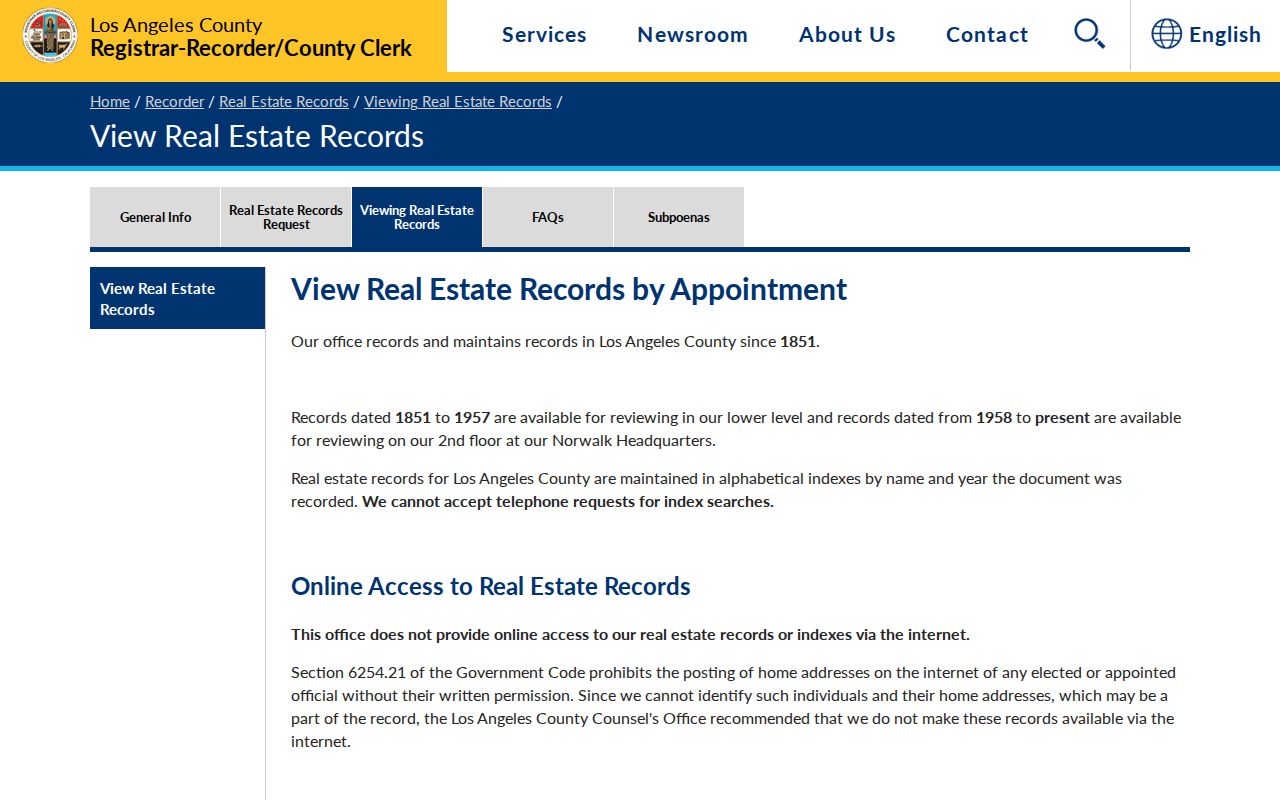
Use the Assessor or city GIS to reach a current owner and deed clue, then use the Norwalk name-and-year index to walk backward. A deed shows title parties, not all occupants.
- Grantor and grantee
- The grantor transfers an interest; the grantee receives it.
- Index
- A finding aid that points to a document, not the complete document image.
- Legal description
- The tract, lot, or boundary language that keeps an old parcel tied to the right land.
- Recorded document
- The filed instrument, such as a deed, lien, release, or deed of trust.
- Roll
- An official list or assessment record maintained for a defined public purpose.
- Criss-cross directory
- A historical reverse directory arranged by street and house number.
- Parcel
- A mapped piece of land with its own identifier and legal description.
Current Diamond Bar Directory Sources
No single current directory lists every Diamond Bar household. A useful set pairs sources with the question each can answer. The city permit archive is arranged first by street name and then by address. Business-license reports run monthly from July 2017, while the County Assessor and GIS tools keep the parcel layer. The county voter service verifies a person's own registration, and an approved voter-file request is a separate, purpose-limited path. Private HOA and congregation lists are not public substitutes.
| Source | People or facts | Keeper | Access |
|---|---|---|---|
| Assessor roll | AIN, situs, legal, value, building facts | Los Angeles County Assessor | Free address or AIN portal |
| Parcel viewer | Boundaries, zoning, displayed ownership | City of Diamond Bar | Free map click |
| Permit archive | Applicants, owners, contractors, work dates | City Building & Safety | Free street and address browse |
| Business-license reports | Businesses and responsible-party clues | City Planning | Monthly PDFs from July 2017 |
| Voter verification | One voter's own status match | Los Angeles County RR/CC | Free four-field self-check |
| Deed index | Recorded ownership parties | Los Angeles County RR/CC | Norwalk index and paid copies |
Access and source quality also differ. Official rolls take more steps but identify the custodian. Commercial people-finder tools may be quick, yet they can merge names or omit the record behind a lead.
| Route | Useful strength | Limit to keep in mind |
|---|---|---|
| City or county official record | Named custodian, date, record type, and correction path | Fields may be narrow, offline, paid, or purpose restricted |
| Library or archive collection | Older directories, newspapers, census, and local context | Coverage and community geography must be checked |
| Commercial compiled lead | May point toward a possible name or address clue | Freshness, matching, source quality, and lawful use vary |
The California Secretary of State's bizfile Online adds entity names, status, formation date, agents, addresses, and filed statements. It can connect a person to a business role, but it cannot turn that role into proof of home residency. The same caution applies to professional-license files and unclaimed-property clues.
The business search screen is an example of a current source that belongs beside, not inside, a Diamond Bar residents directory. It names entities and filings rather than every neighbor.
Compare the entity address and city permit evidence, then verify the record with the named custodian before drawing a personal conclusion.
Diamond Bar Court Records Search
Diamond Bar has no municipal court. State cases belong to the Los Angeles Superior Court, and federal cases use the Central District of California and PACER. The Superior Court's Find a Case service separates Case Access, Case Calendar, Case Document Images, party-name searches for civil, family, probate, and small claims matters, and defendant-name searches for criminal matters. A case-number search is the basic public route. A paid name search can find candidate case numbers, but a shared name needs more anchors.
- Case-number access
- Shows caption, filing date, court location, type, status, hearings, and public register entries.
- Paid name search
- Uses party or defendant name, case family, date range, and courthouse options; purchased results remain available for 24 hours.
- Document images
- Selected civil, probate, and small-claims images may be purchased; criminal and family images are not published through the general image system.
- Counter fallback
- Courthouse kiosks and clerk windows can provide broader access by case number, with retrieval and copy fees.
The public-facing search choices are visible in the official court interface.
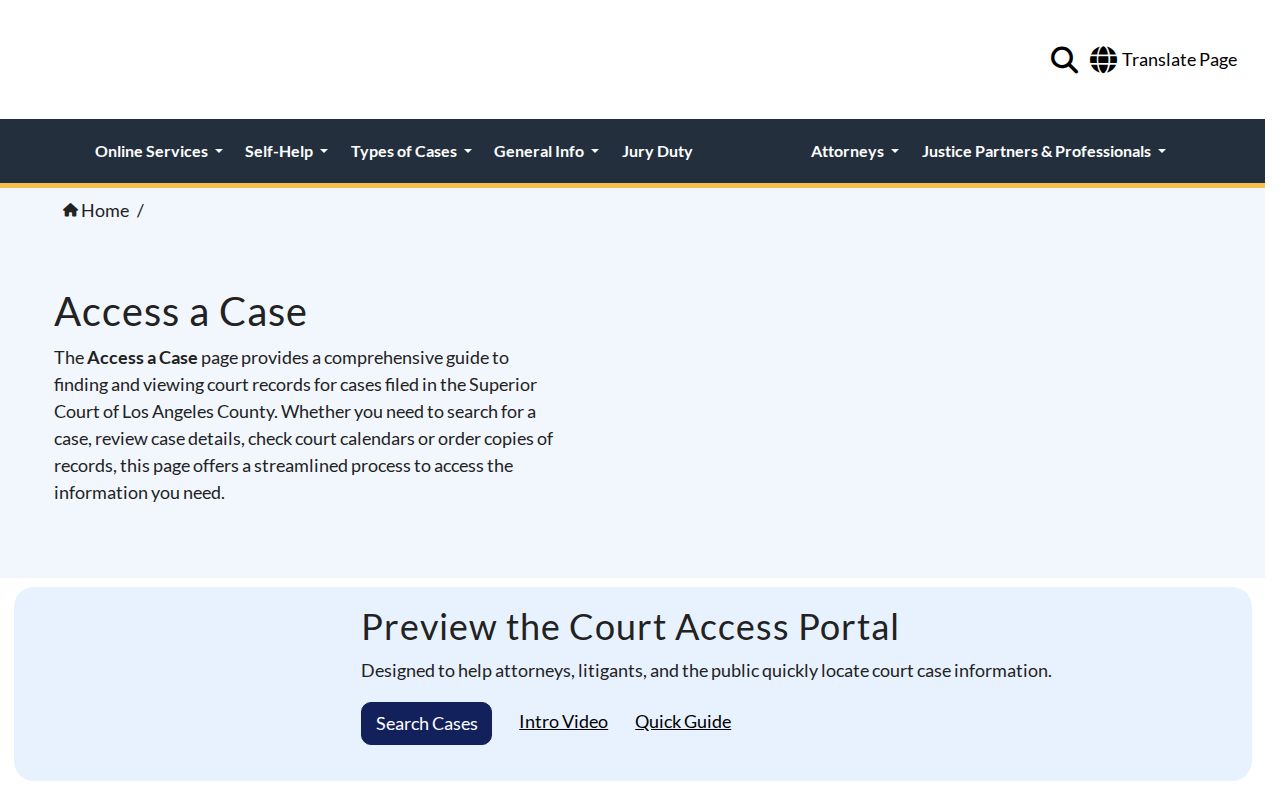
A court result confirms a case relationship or filing trail. It does not by itself prove that a party lives in Diamond Bar today.
Diamond Bar Voter Verification
The county voter tool is deliberately narrow. It asks for Last Name, Birthdate, Residence House Number, and ZIP Code, with all four values required. The service is designed for a voter to confirm a registration match and election information. It is not a name-and-street browser for the Diamond Bar residents directory. The broader voter file is available only through a written application for an approved purpose under Elections Code sections 2188, 2188.5, and 2194 and related California regulations.
The official verification form identifies the four-field match.
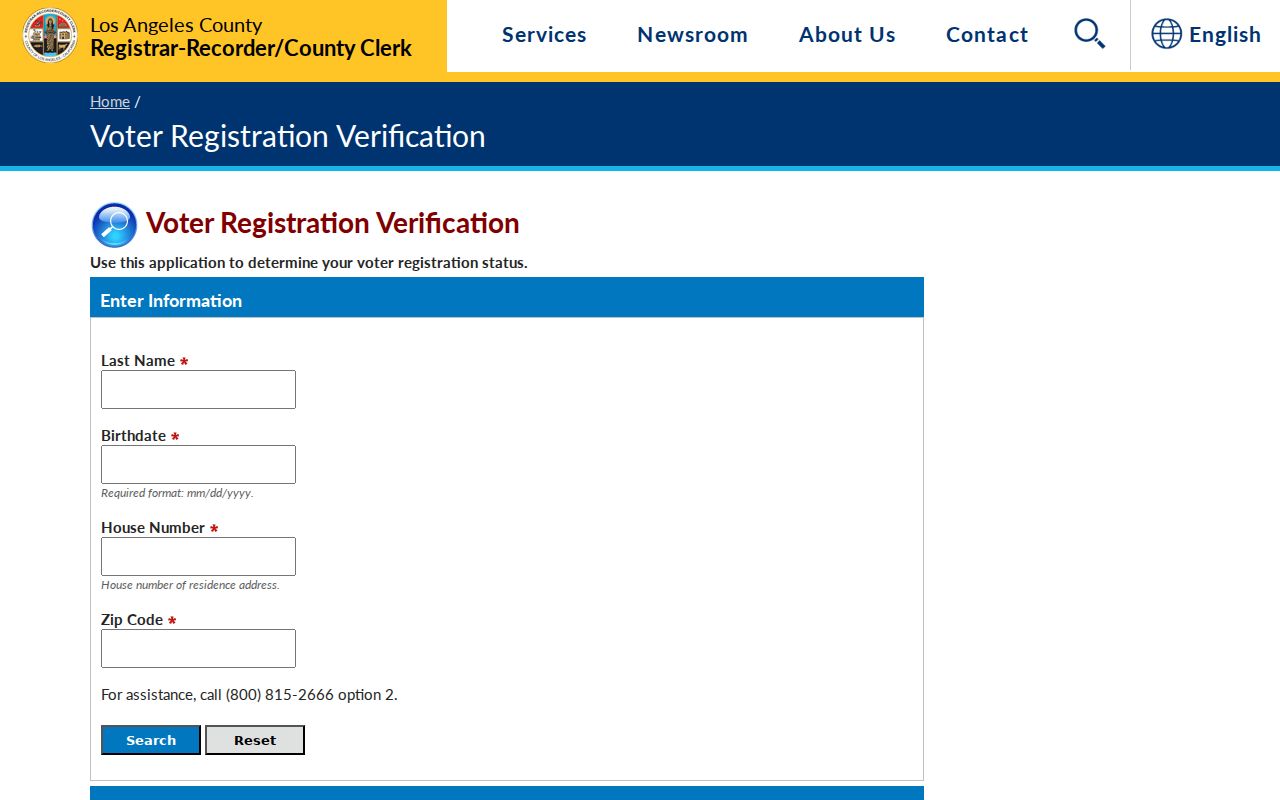
For a qualifying data request, the County Election Information Section in Norwalk uses an application that asks for the requester, purpose, jurisdictions, file type, media, election or history fields, and processing details. The county help line is (800) 815-2666, option 2. Voter data cannot be used for private solicitation or harassment, and confidential voters are protected.
Diamond Bar Vital Record Routes
Birth, death, and marriage records for Diamond Bar are county or state records, not city files. Los Angeles County RR/CC maintains county births since 1866 and county death and marriage records. The California Department of Public Health supplies statewide applications. Current-year and one-prior-year births and deaths may also be available through the local registrar. A divorce decree comes from Los Angeles Superior Court, while CDPH's dissolution certificate gives more limited record information.
Eligibility is more important than a ZIP search. Authorized certified copies are limited to statutory persons. Other requesters can generally seek informational certified copies of ordinary birth, death, and public-marriage records. Confidential marriage records are closed except to a spouse or by court order under Family Code sections 509 through 511. Adoption files and original birth records are confidential. Applications can be online, in person, or by mail, and the state search fee is retained even when no record is found.
- County birth copy
- The 2026 county listing gives a $34 base fee and a 20-business-day processing statement, plus any VitalChek handling.
- State birth application
- CDPH lists $31 for VS 111 in 2026, with authorized or informational copy choices.
- Marriage record
- Public marriage follows the county of license; confidential marriage needs spouse eligibility or a court order.
- Mail request
- Applications need record facts, requester details, copy type, payment, and a sworn statement or notarization when the instructions require it.
Use the California vital-record forms and the county record page rather than looking for a Diamond Bar-only vital index.
Diamond Bar's Ranch-to-Home Record Trail
Diamond Bar's record history is unusually important to a resident search. Rancho Los Nogales dates to an 1840 Mexican land grant. The land changed hands through Ricardo Vejar, Louis Phillips, the Lewis and Bartholome families, and the Diamond Bar ranch era before Transamerica bought 8,000 acres in 1956. The first northern model homes opened in 1960. The city incorporated on April 18, 1989. A modern street address may therefore have no direct meaning in a nineteenth-century source.
- For land before the city, search the legal description, ranch name, Spadra, Walnut Valley, or Pomona vicinity.
- For the development era, pair subdivision deeds and permits with the first model-home and tract evidence.
- For post-incorporation civic records, search City Council, commission, and History Project material.
- For a household, keep title owners, permit participants, and enumerated residents in separate evidence columns.
The city history chronology helps explain why a directory hit under a neighboring place name may still matter, but “Spadra” is not a synonym for every modern Diamond Bar parcel.
Diamond Bar ZIP Geography
Most Diamond Bar addresses use ZIP Code 91765, but postal geography and city limits are different systems. Historically, roughly 3,000 residents and businesses in the city's northern or western interface used Walnut ZIP 91789. In October 2011 the city promoted a USPS survey to consolidate addresses into 91765. The change matters when a directory, newspaper, license, or old form uses Walnut as the postal identity. Check each address in USPS ZIP Lookup instead of reading a ZIP from a map radius.
City GIS establishes whether a parcel sits inside the incorporated boundary. USPS establishes delivery routing. Los Angeles County establishes the parcel and tax geography. Walnut Valley Unified and Pomona Unified establish school-service geography. A Diamond Bar residents directory is clearer when those lines are recorded side by side rather than treated as one boundary.
Historical Diamond Bar Directories
The Los Angeles Public Library's digitized Los Angeles-area city and street-address directories span 1875 to 1987, with ResCarta metadata showing historic city, business, and phone directories from 1873 to 1970 and reverse directories in 1906, 1927, and 1956 through 1987. Those labels do not guarantee Diamond Bar coverage. Search the publication front matter, community list, and page image before treating a name as a local hit. Directory entries may show a name, spouse, occupation, h householder mark, r resident mark, and street address, but omission is not proof that a person was absent.
The full collection method belongs on the Diamond Bar city directory page. For a quick start, try historic place names and spelling variants, and remember that reverse volumes may write an address as “Ave 64” or “Avenue Sixty-Four.”
Diamond Bar Historical Archive Trail
The Diamond Bar Library offers in-person and telephone research help, catalog and database access, newspapers, and Chinese-language holdings. Its local branch opened in 1977, moved to the City Hall site in 2012, and can help route a question to the County Californiana Collection. That collection sits in closed stacks at Norwalk Library and includes nineteenth-century directories, California census schedules from 1850 through 1910, newspapers, and official histories. Call before travel because the online description does not publish a dedicated Diamond Bar directory run.
For deeper family research, the California State Archives catalogs genealogy holdings, and NARA Riverside holds Los Angeles naturalization indexes and petitions. A narrow CPRA request is another fallback for a missing city file. Describe the address or APN, a date range, the record category, and the preferred electronic format. The city's form has no submission fee, though physical duplication can be charged.
The city's official records-request route shows the local fallback when a search box does not return a needed file.
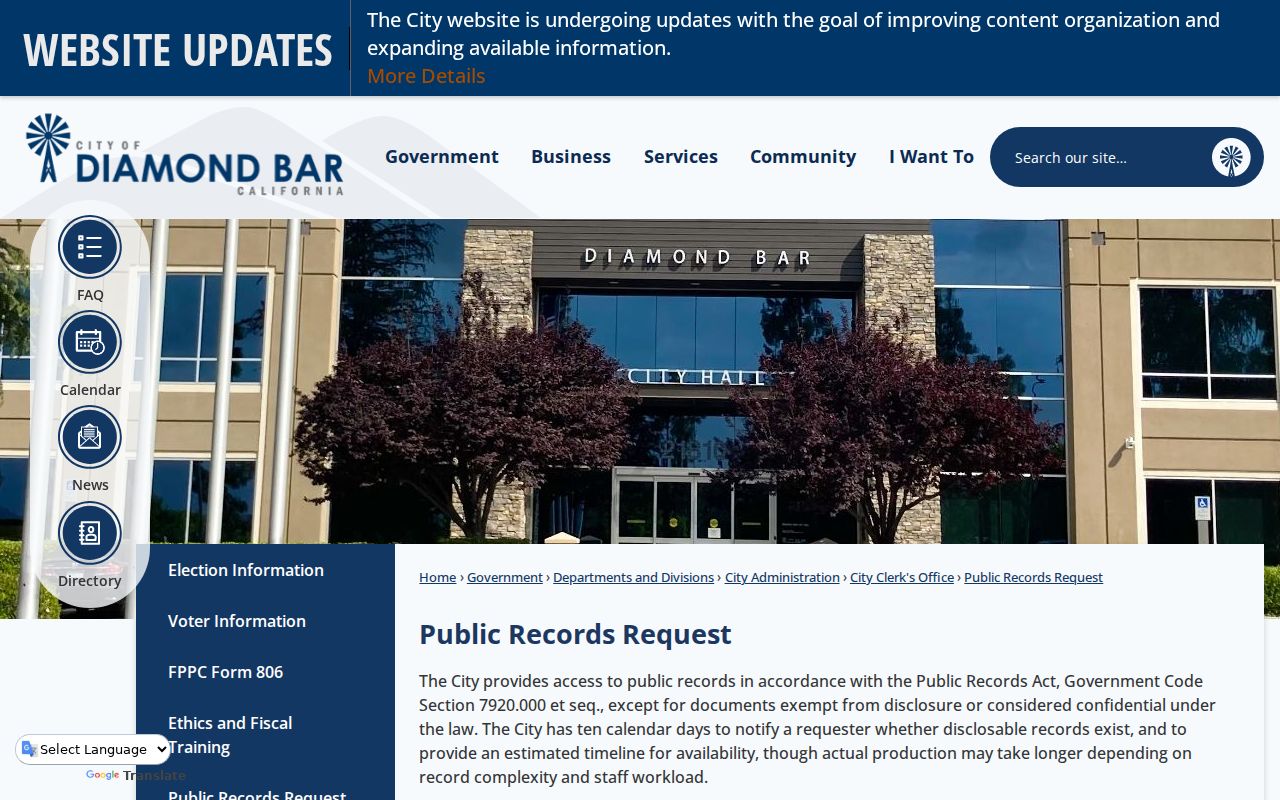
A request should name the custodian and record, not ask an office to create a new resident list.
Diamond Bar Address Privacy Rules
California's Safe at Home program can give eligible survivors and threatened covered workers a substitute mailing address and mail forwarding. Government Code sections 6205 and following govern the program, and qualifying participants can request special treatment for certain deeds and change-of-ownership filings. A substitute address is not an identity change, and a legal description may still reveal property location. Recorded documents generally cannot be erased by a simple opt-out request; a court order is a different process.
Lawful personal use. Public records support family history, property research, civic review, and personal safety. Do not use a Diamond Bar resident record to stalk, harass, threaten, or harm anyone, and verify sensitive facts with the custodian before acting.
California's voter-data restrictions, the federal Driver's Privacy Protection Act, and confidential records rules also explain why a complete residents directory cannot be built from public sources. A missing name can reflect a protected program, a closed record, a different postal identity, or a simple coverage gap.
Recent Diamond Bar Records Changes
Records access is a moving system feature. California's 2026 Delete Request and Opt-out Platform, known as DROP, lets a resident send one encrypted deletion or no-sale request to more than 500 registered data brokers. Processing duties begin August 1, 2026. That tool concerns commercial data exposure, not the removal of a lawful county deed or court file.
Los Angeles Superior Court redesigned its website in 2025 after the 2024 ransomware disruption, and courthouse kiosks have expanded some public access. Los Angeles County's Homeowner Notification Program pairs mailed copies of qualifying ownership, loan, default, or sale documents with optional email notice through an Assessor portal profile. Use official .gov or .ca.gov addresses when checking a notice or fee.
These changes make the Diamond Bar residents directory more useful when each result carries a date, source link, record type, and custodian. They also make verification a standing part of the search rather than a final afterthought.