
Diamond Bar City Directory Collections
The collection map should come before a name search. A publication can carry a Los Angeles label while covering only selected communities, and a reverse volume can list a street without covering every eastern-county tract. The rows below show where to begin and where a gap is known.
| Collection | Years | Where held | Access |
|---|---|---|---|
| LAPL historic city, business, phone directories | 1873-1970 metadata range | LAPL ResCarta | Free OCR and page images; check communities |
| LAPL reverse directories | 1906, 1927, 1956-1987 | LAPL ResCarta | Address-first browse; coverage varies |
| Los Angeles-area city and street-address shelf | 1875-1987 broad range | Los Angeles Public Library | Digitized browse; front matter controls fit |
| Californiana Collection | Nineteenth century directories and local histories | Norwalk Library closed stacks | Call or ask a reference librarian |
| U.S. Census schedules | 1850-1950 public in 2026 | NARA and partner databases | Historic geography may not say Diamond Bar |
| Naturalization series | County 1852-1915; federal indexes and petitions through later years | NARA Riverside | Catalog, research room, or copy request |
| Diamond Bar History Project | Ranch, development, and incorporation eras | City Community Relations | Contact for donated items and oral histories |
No official shelf list establishing a dedicated, continuous Diamond Bar Polk or criss-cross run was located. Treat that absence as a research gap to resolve with library staff, not as proof that no local volume exists.
Diamond Bar's Missing City Directory Run
A nineteenth-century local directory for Diamond Bar would be an anachronism. Transamerica bought 8,000 ranch acres in 1956, opened the first model homes in 1960, and the city incorporated on April 18, 1989. Earlier people were attached to ranch land, county townships, Spadra, Walnut Valley, Pomona, or a postal route rather than a city government named Diamond Bar. A search that asks only for the modern city can miss the correct historical record.
Before the first tract homes, use the legal description, ranch name, newspaper place line, or county precinct. After construction, pair directories with permits, deeds, subdivision maps, and the 1950 census. City Council and planning files become more useful after incorporation. This is why the regional shelf is best read as a local set with verification.
The city history chronology supplies the land-to-community timeline. “Spadra” can be a clue, but it is not a substitute for matching the parcel or historic map.
Diamond Bar City Directory Years
The Los Angeles Public Library digitized Los Angeles-area city and street-address directories from 1875 through 1987. ResCarta describes a historic city, business, and phone collection from 1873 through 1970, plus Los Angeles Street-Reverse Directories for 1906, 1927, and 1956 through 1987. The shelf includes examples such as the 1873 Los Angeles directory, the Southern California Directory from 1875, the 1882 Los Angeles Telephone Directory, the 1883-84 Los Angeles and Santa Ana Valley volume, and later Polk and telephone volumes.
Publishers, coverage communities, and abbreviations change by volume. Read the title page and front matter before using a name. A directory entry can show a spouse, occupation, employer or business, householder mark, residence mark, street, and phone, but a missing entry can reflect nonresponse, no telephone, a boundary mismatch, or a skipped publication year.
The LAPL digitized directory landing page is the source for the broad year range.
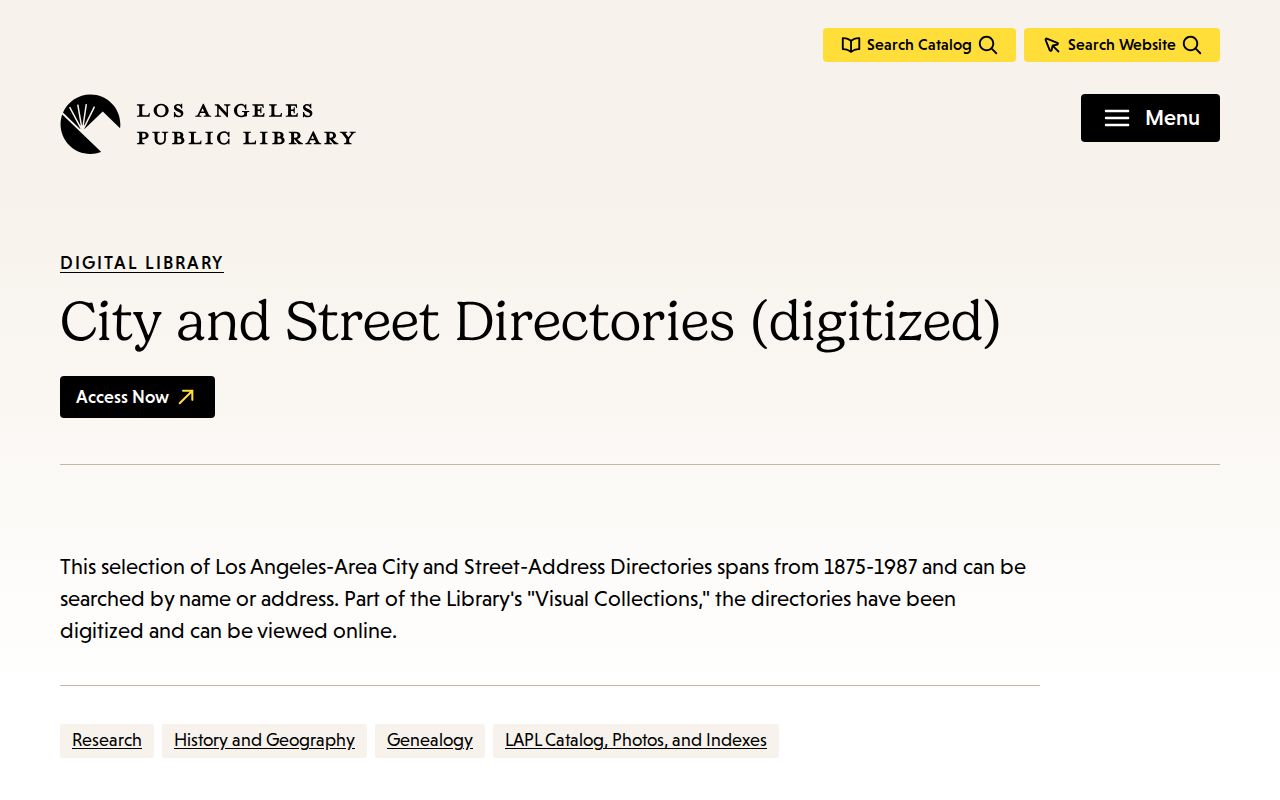
The digitized shelf gives a city directory researcher a page image to cite, but the community list still decides whether a hit belongs to Diamond Bar.
Diamond Bar City Directory Reverse Codes
ResCarta supports two search styles. Browse titles to pick a publication, or open a volume and use the magnifying-glass Search Object control for OCR within that directory. A reverse volume begins with a street heading and ascending house number. A name directory begins with an alphabetic entry and may give the householder's address. Diamond Bar searches need both.
| Collection | Choose All, Historic City and Business & Phone Directories, or Los Angeles Street-Reverse Directories. |
|---|---|
| Simple Search | OCR keyword search across the selected scope. |
| Search Object | Text search within the open volume after selecting the magnifying-glass control. |
| Sort | Publication Date or Title, with selectable order. |
| Page controls | Thumbnail and page-image navigation for checking OCR. |
Historic address codes are the insider tip. An h often precedes a householder's address and an r a resident's address, so search a form such as h443 N Av 52 rather than only the number. Test “Ave 64” and “Avenue Sixty-Four,” and try “Broadway” and “Bway.” OCR is imperfect, so inspect the page image.
The ResCarta collection browser shows the browse and search controls used for the Diamond Bar regional directory trail.
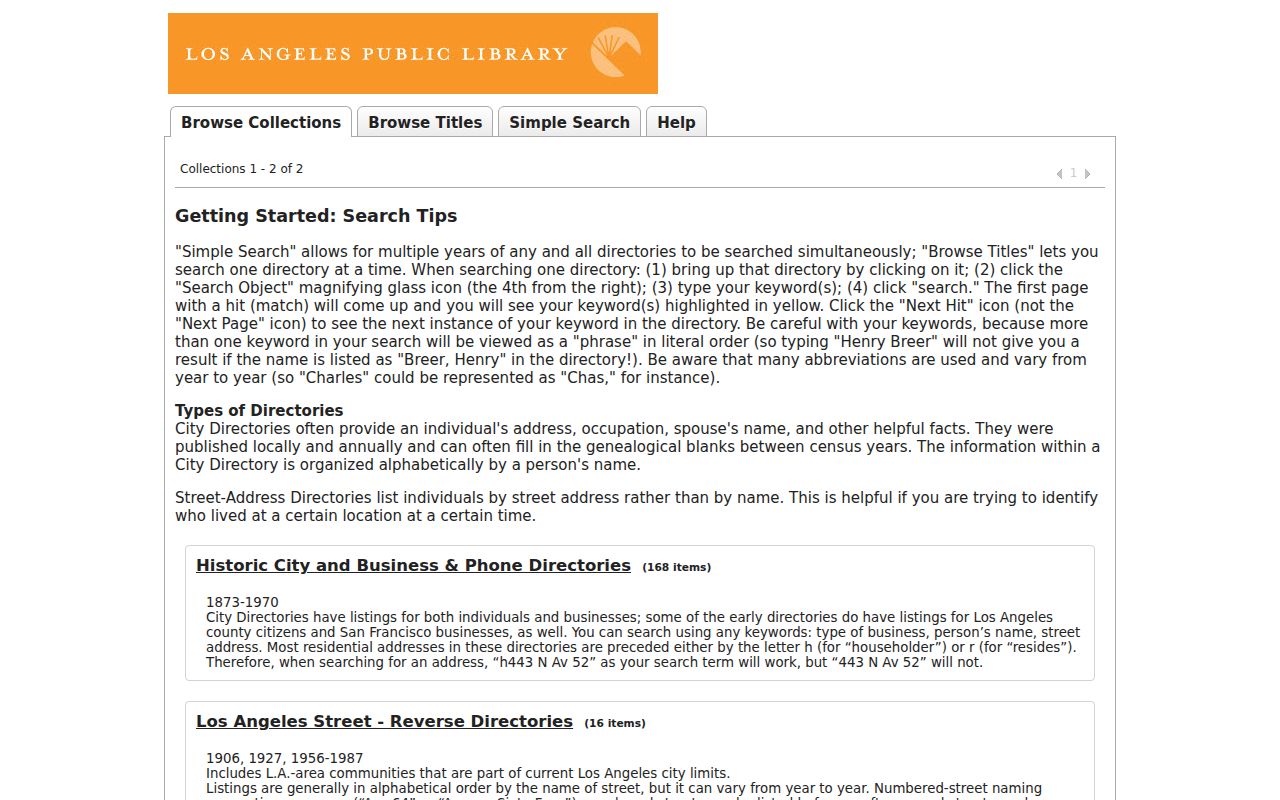
Search syntax is part of the evidence. Save the volume, page, OCR phrase, and image when an address produces a useful entry.
Reading a Diamond Bar City Directory
A directory entry is a compact record, not a modern profile. Read it from left to right and copy the abbreviations before expanding them. In a typical alphabetic entry, surname and given name come first, followed by spouse or widow notation, occupation, employer or business, an h or r marker, street address, and sometimes a phone number. A reverse entry starts at a street heading, moves through house numbers, and names the listed occupant or business.
- Identity: surname, given name, initials, spouse, widow notation, and spelling variant.
- Address: street heading, house number, directional, apartment or business line, and cross-street clue.
- Role: householder, resident, proprietor, employee, or office contact as the volume labels it.
- Publication: title, publisher, year, communities covered, and abbreviation key.
- Limits: a private compilation that may omit people or use a postal boundary different from Diamond Bar.
- Criss-cross directory
- A reverse directory arranged by street and number rather than only by surname.
- Householder index
- An address or name clue for the person treated as the head of a listed household.
- Abbreviation key
- The publisher's guide to marks such as h, r, wid, occupations, and street short forms.
- OCR
- Machine-read text that speeds searching but must be checked against the scanned page.
Diamond Bar City Directory Development
The local directory story turns on land use. Rancho Los Nogales and the Diamond Bar ranch supplied the earlier land context. Transamerica's 1956 purchase and the 1960 model homes created the address world that later reverse directories could record. The Diamond Bar Homeowners Association formed in 1960, a Municipal Advisory Council followed in the 1970s, and incorporation arrived in 1989.
- 1840: Rancho Los Nogales is the historic land anchor for the eastern Walnut Valley.
- 1956: Transamerica buys the ranch acreage and plans a large master-planned community.
- 1960: The first northern model homes create modern tract addresses.
- 1989: Diamond Bar becomes the county's 86th incorporated city.
The official history page supports the timeline. For a household search, use the development date to decide whether a modern address can exist in the directory year being tested.
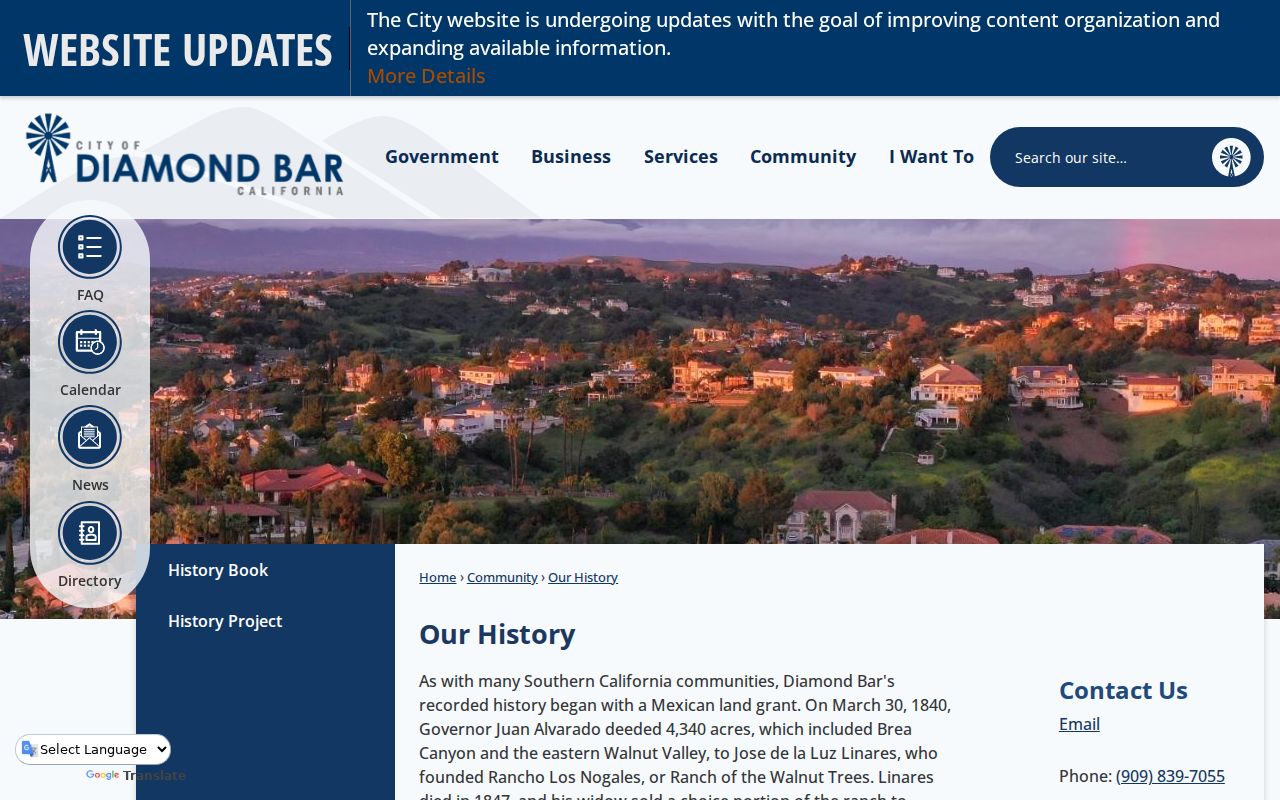
Development history keeps a directory result tied to the right era. It also explains why a ranch name can matter more than a city label in an early source.
Diamond Bar Californiana Directory Stacks
The Los Angeles County Library's Californiana Collection is held in closed stacks at Norwalk Library, 12350 Imperial Highway. It contains more than 24,000 books, over 200 magazine and newspaper titles on paper or microfilm, California census schedules from 1850 through 1910, nineteenth-century city directories, and official city and county histories. The online description does not publish an itemized Diamond Bar year run. Ask staff to search Diamond Bar, Spadra, Pomona, Walnut, and eastern San Gabriel Valley together.
Diamond Bar Library at 21800 Copley Drive offers in-person and telephone research help, catalog and database access, Los Angeles Times access, and Chinese-language holdings. Its branch history, including the 1977 opening and 2012 City Hall move, can help locate newspaper, school, and community evidence. Call before travel to confirm the shelf or a reference request.
The County local-history description explains the larger collection.
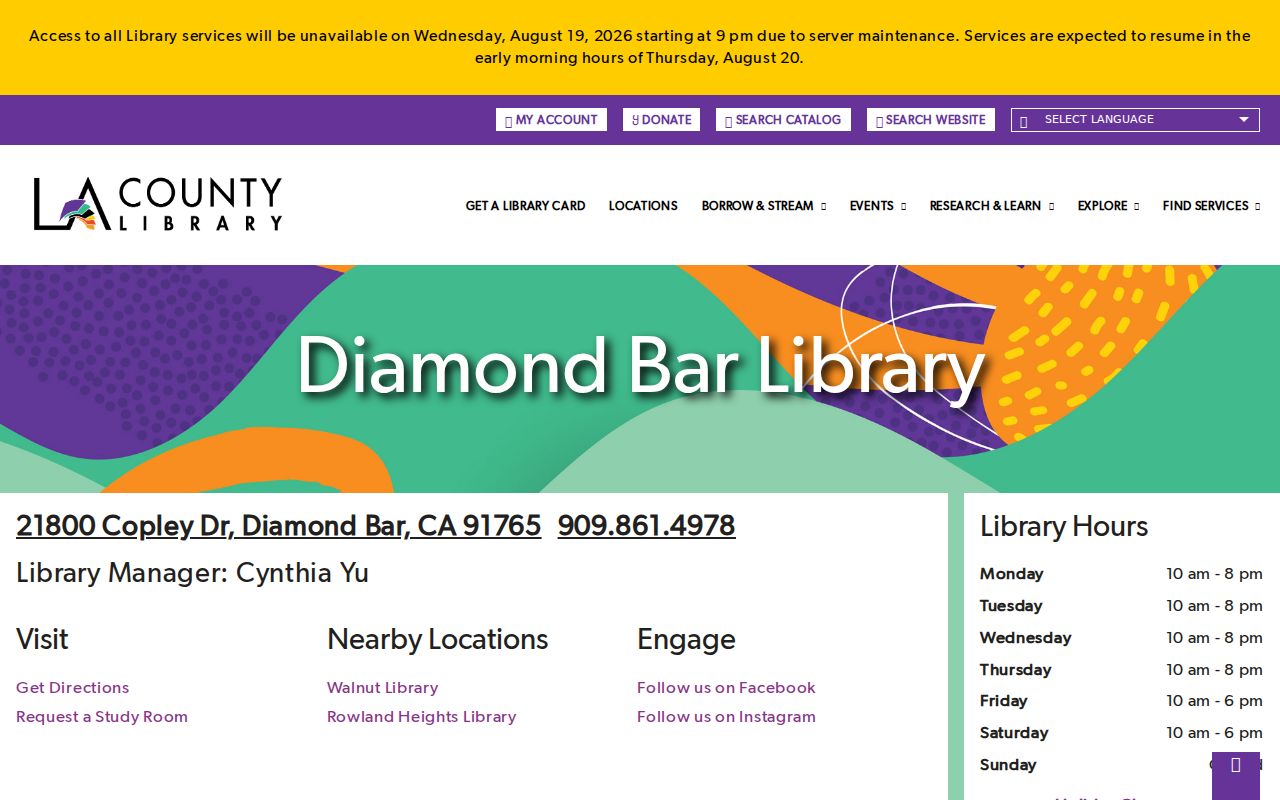
Closed stacks are an access channel, not a dead end. A librarian can identify a volume that an online catalog search never exposes.
Tracing a Diamond Bar Directory Household
Pair a directory year with an independent record. The goal is to show how a household appears, changes address, or disappears, without assuming that one omission tells the whole story. The workflow below works best when the address and name are copied exactly at each step.
- Establish the modern APN, legal description, subdivision, and earliest construction clue. A home built after 1960 needs development evidence before a nineteenth-century directory search.
- Choose a reverse volume whose front matter includes the target community. Search street variants and the house number, then inspect the page image.
- Search the alphabetic section for each occupant and spouse. Record occupation, address, h or r mark, publisher, year, and page.
- Pair a 1960s directory or tract clue with the 1950 census, the latest public enumeration under the 72-year rule in 2026. Keep census occupants separate from deed owners.
- Use permits, newspapers, obituaries, probate, and naturalization to resolve a move, death, or name change. Confirm any modern person through an official current record.
When a directory hit needs a current check, shift to the Diamond Bar resident lookup. When the task is the current address chain, use the street directory by address instead of repeating the historical shelf.
Diamond Bar Directory History Sources
The Diamond Bar History Project collects the material that formal directories often miss: Transamerica documents from the 1950s through the 1980s, early tract brochures, Country and golf-course photographs, ranch artifacts, old maps, Windmill magazines, incorporation campaign material, and resident oral histories. Community Relations invites donated, loaned, or recorded memories at (909) 839-7055.
These sources can put a person or street into a development story, but an oral history is not a title record and a photograph is not a complete directory. Cite the item, date, donor or speaker when available, then compare the claim with permits, deeds, newspapers, or a directory page.
The Diamond Bar History Project page is the source for its collecting invitation.
Local memory supplies names and context that can guide a collection search, while the dated item keeps the story anchored.