
Previous Residents of a Diamond Bar Address
The backward trail begins with an era map. Recorded land records reach back to 1851, while the modern city did not incorporate until 1989. Reverse directories overlap the development era but may not include every eastern-county community. The table separates what each source can actually show.
| Source | Years it covers | Where held | What it shows |
|---|---|---|---|
| Recorded land records | 1851-present; copy page also says 1850 | RR/CC Norwalk | Ownership instruments, liens, legal descriptions |
| Modern recorder index | 1958-present | Norwalk second floor | Grantor, grantee, year, document locator |
| Historic recorder books | 1851-1957 | Norwalk lower level | Pre-digital chain and older books |
| City permits | Approved archive; first year not stated | Diamond Bar Online Records Library | Construction and project participants |
| LAPL reverse directories | 1956-1987 relevant era | Online ResCarta | Address-to-occupant where the volume covers |
| U.S. Census | 1850-1950 public in 2026 | NARA and partners | Enumerated household in historic geography |
| History Project | 1950s-1980s development focus | City Community Relations | Brochures, maps, photos, and oral histories |
There is no verified dedicated Diamond Bar Sanborn sheet series in the official material reviewed. Check Library of Congress or LAPL by Spadra and Pomona, but do not promise a Diamond Bar sheet.
Diamond Bar Previous Residents Parcel Trail
A past-resident search fails if the modern address is not tied to the right land. Search the city Property Parcel Viewer or County Assessor by site address. Capture APN or AIN, legal description, tract or lot, parcel shape, zoning, current roll clues, and adjoining lots. Keep situs address and mailing address separate. A postal label can change while the legal parcel stays the same.
- Search the address in city GIS and county Assessor tools.
- Save the parcel map, APN or AIN, legal description, subdivision, and current transfer clue.
- Check the city permit archive for the earliest construction, tract, or owner-builder entry.
- Write the exact current owner or known document number only when the official result supplies it.
The city GIS hub and Assessor Portal are the first two access channels. Their parcel facts establish the bridge to a deed, not the identity of every previous resident.
Diamond Bar Previous Residents: Follow Sellers
Los Angeles County's real-estate index is alphabetical by grantor and grantee, year, and party name. It is not an online address index. Once the current acquisition document is known, search the seller as an earlier grantee, then repeat with the preceding seller. Match APN, legal description, document type, and recording date at each step. A surname match alone is not enough.
- Locate the current acquisition document through owner paperwork, transfer clues, or the RR/CC counter.
- Copy exact grantee, grantor, recording date, document number, book or page, and legal description.
- Search the grantor as grantee in the prior year range and compare the parcel language.
- Continue backward until the chain reaches a subdivider, developer, ranch parcel, or the historic books.
- Order a known document online, by mail, or in person when an image is needed.
The deed chain tracks title, not a list of previous residents. Use directories, census, permits, obituaries, and probate for the household layer.
- Grantor and grantee
- The grantor transfers an interest; the grantee receives it in the recorded instrument.
- Chain of title
- The linked sequence of recorded transfers that traces an interest backward through prior owners.
- Legal description
- Lot, tract, or boundary language that identifies land more reliably than an old street label.
At Norwalk, the Real Estate Records Room is at 12400 Imperial Highway, and RR/CC lists (800) 201-8999 for the recorder function. The index search is an in-person channel, while a known document can be ordered through the county online vendor, by mail, or at the counter. Record the exact document number before ordering. Copy fees, payment methods, and processing terms belong to the current county fee page, not to a general estimate.
Diamond Bar Previous Residents Index Break
Norwalk divides the practical search by year. Records from 1958 to the present are reviewed on the second floor. The 1851-1957 books are on the lower level. The county's public web pages explain that the full index stays offline because posting protected officials' home addresses could create a safety problem. The date split is therefore an access fact, not a gap in the underlying land history.
The RR/CC viewing page describes the floors, appointment setting, and Norwalk visit. The copy-order route states a 20-working-day online processing statement and requires the complete document.
Note: Confirm whether a requested early deed is treated as 1850 or 1851 because RR/CC pages describe the start year differently.
Diamond Bar Previous Residents and Ranch Land
For many Diamond Bar homes, the deed chain soon stops looking like a household list. Rancho Los Nogales began as an 1840 Mexican grant. Later land passed through Ricardo Vejar, Louis Phillips, the Lewis and Bartholome families, and the Diamond Bar ranch before Transamerica purchased 8,000 acres for $10 million in 1956. The first northern model homes opened in 1960. An older legal description may lead to a ranch or developer, not a person who lived in the later tract house.
That is the local story layer. A title record can establish how the land moved. A permit can date a first structure. A directory can name a listed household. A city history item can explain why the address did not exist in the earlier era. Do not collapse those evidence types into one continuous claim about earlier households.
The Diamond Bar history page is the source for the land and development chronology.
Diamond Bar Previous Residents and Permits
The city permit archive is a strong bridge between land history and people history. Search by street and house number, then capture permit number, type, job description, issue and final dates, owner, applicant, contractor, valuation, and inspection status. The earliest permit or tract record can show when a modern address entered the built environment. Later remodel, solar, pool, and owner-builder entries can mark a change without naming every occupant.
Building & Safety can help with copies at (909) 839-7020. Planning can answer zoning and property-line questions at (909) 839-7030. If a code case or notice is not in the public library, file a narrow city CPRA request. The city says it will determine within 10 calendar days whether responsive disclosable records exist, though a complex production can take longer.
For current address evidence, use the Diamond Bar street directory. Its parcel and permit angle complements the backward trail here.
Can Diamond Bar Reverse Directories Cover This
LAPL reverse directories from 1956 through 1987 overlap Diamond Bar's development years, but selected-county coverage must be proven volume by volume. Open the ResCarta title, read the front matter, and confirm the community list. Search a street heading and house number, then test the alphabetic name section. Try address variants, house-number continuity, Walnut, Pomona, Spadra, and Walnut Valley when the postal geography suggests a shift.
OCR can miss a scan. Inspect the page image and save the publisher, volume year, page, entry text, and any h or r address mark. A reverse directory may name an occupant or business. It can omit a household because of no telephone, nonresponse, boundary mismatch, or a publication gap.
The LAPL ResCarta browser is the digital channel, while the Diamond Bar Library and Norwalk Californiana Collection provide staff and shelf fallbacks.
The National Archives naturalization page is another historical access route when a person's migration story fits the record.
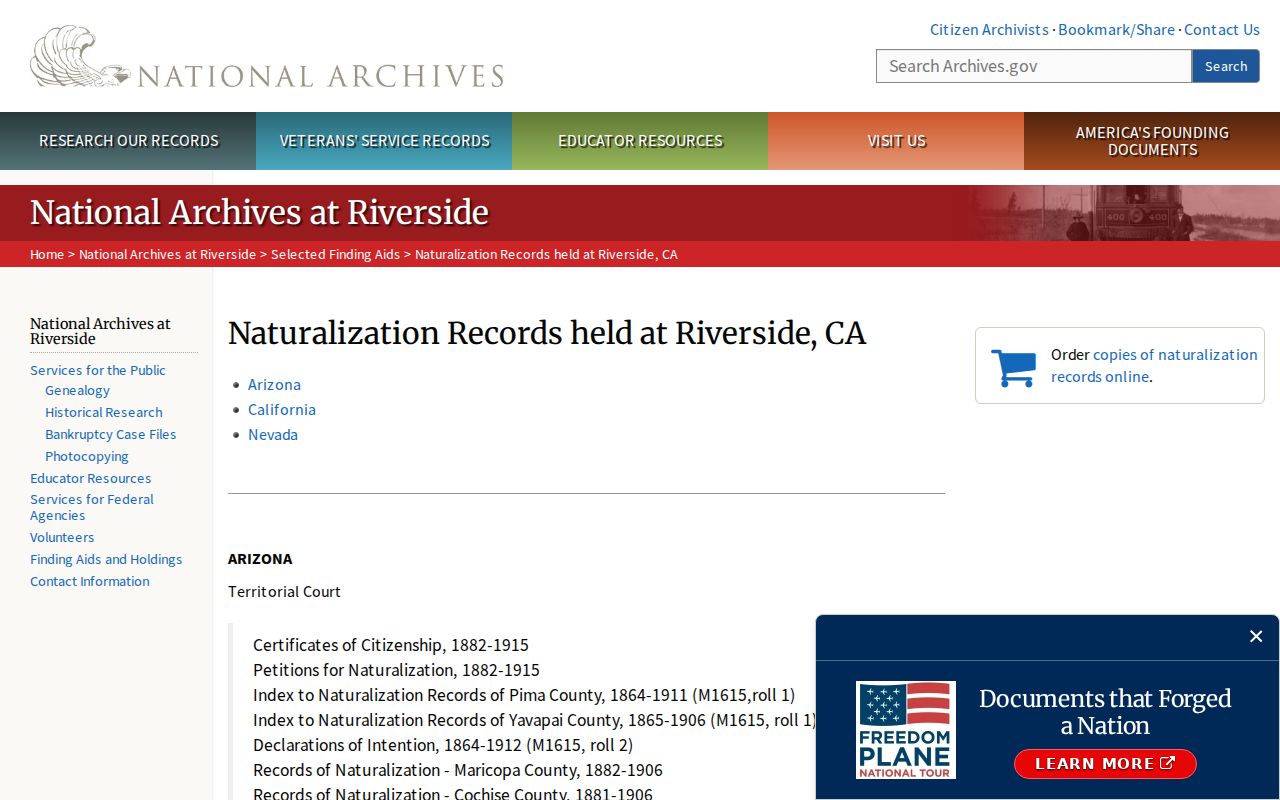
NARA Riverside holds Los Angeles federal and county naturalization series, but a naturalization record is an identity clue, not proof that someone occupied the target address.
Diamond Bar Previous Households and Obituaries
Owners are only one layer of the address history. Census schedules enumerate a household at a historic geography. Reverse directories provide a publication-year snapshot. Obituaries and newspapers can explain a departure or death. Probate petitions can name heirs, and a recorded distribution deed can connect the estate to land. Pair the sources by date rather than asking one source to prove all of them.
- Place a directory year beside the nearest public census year, keeping owners and occupants in separate notes.
- Search newspapers and obituaries for the name, spouse, street, ranch, or neighborhood.
- Search Superior Court probate by case number or paid party name, then inspect public petitions or distributions.
- Use a birth or death copy only when the requester meets the eligibility and copy rules.
Los Angeles County birth records begin in 1866. County and CDPH routes differ by record type and copy class.
The county's birth-record ordering page explains one official access route.
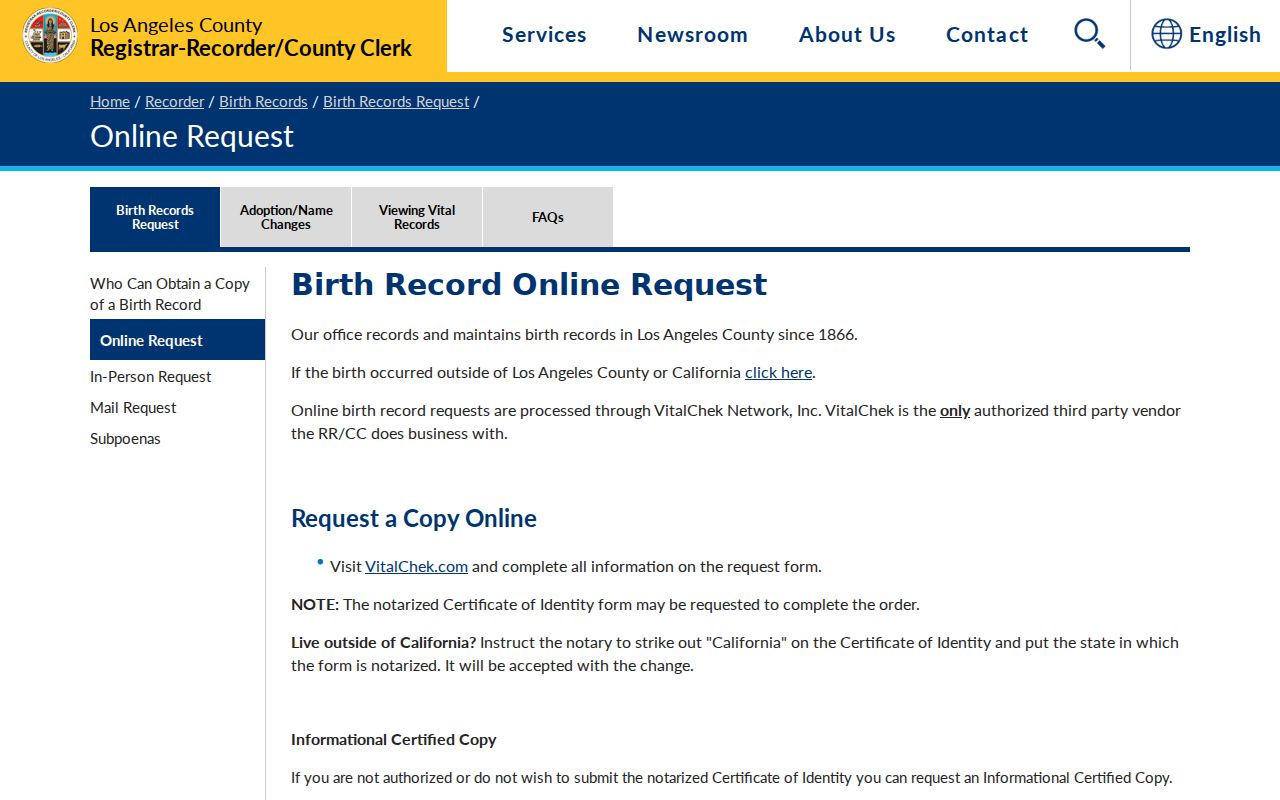
A vital record can confirm an event and identity, but it does not automatically place a person at the target address.
Lawful house history. Previous-resident research is for family history, genealogy, property history, and personal curiosity. Do not use it to follow, harass, threaten, intimidate, or harm a living person.
For a missing obituary or directory entry, ask Diamond Bar Library or the County Californiana reference desk about newspaper and microfilm holdings. The California State Archives catalogs probate, naturalization, deed, vital, and Great Register material, while NARA Riverside holds Los Angeles naturalization indexes and petitions. These are counter, mail, catalog, or reference channels rather than instant address searches.
Search Both Diamond Bar Postal Identities
Use 91765 and Walnut 91789 when a record falls near the historical interface. The 2011 consolidation campaign means the same tract may appear under both postal names. Search both city labels in directories, newspapers, business records, and older forms, then use parcel shape, legal description, and date to confirm the land.
USPS determines routing. City GIS determines the incorporated boundary. The County Assessor and recorder determine parcel and title records. A postal match can guide a previous-residents search, but it cannot prove an occupant or alter the chain of title.
For a federal case clue connected to an estate, land dispute, or name, PACER is the separate access channel.
PACER may identify a federal docket and document, but its party search is not a local resident directory and its fees and access rules apply.