
How Diamond Bar Residents Are Found
Diamond Bar is an incorporated city, yet it is not a separate county records jurisdiction. City Hall keeps permits, business-license reports, agendas, and code files. Los Angeles County holds the deeds, vital records, voter rolls, assessments, and court files. That split shapes any residents directory. An owner clue comes from the Assessor or the city parcel viewer. A recorded transfer lives with the Registrar-Recorder/County Clerk. A court party search can confirm a case trail. A library volume may place a household in an earlier year. Each record answers a narrower question than the word resident suggests.
A name search and an address search are different tasks. The Assessor portal starts with an AIN or address and advertises no public owner-name mode. The city GIS viewer adds parcel boundaries, zoning, and ownership. The voter tool is a self-verification form. It is not a public street roll. Older households are harder. Diamond Bar grew from ranch land and a master-planned community. It grew after the classic directory era. The Los Angeles Public Library's OCR shelf and the county Californiana Collection may still help. Their geographic coverage must be checked.
- Start with the standardized street address in the Los Angeles County Assessor Portal or the city Property Parcel Viewer. Save the AIN, legal description, map result, and any transfer clue.
- Use the Diamond Bar permit archive and municipal records library to test the same street and house number. An applicant or contractor is evidence of a project, not proof of residence.
- Use the Los Angeles County voter verification service only for a person's own matching check. It requires last name, birthdate, residence house number, and ZIP.
- Carry a known party name and recording year to the RR/CC index in Norwalk. The deed index is arranged by grantor or grantee and year, not by address on the public web.
- For past households, compare reverse-directory entries, census schedules, permits, obituaries, and probate. If a city file is missing, submit a narrow request through the Diamond Bar public-records route or ask a library reference desk.
This keeps the Diamond Bar residents directory grounded. It also stops one same-name hit from becoming a claim about the wrong person.
Where Diamond Bar Keeps Resident Records
Three offices anchor the map. The Diamond Bar City Clerk handles transparency and routes municipal file requests. The County Assessor supplies parcel facts. Deeds and vital records sit with the Registrar-Recorder/County Clerk, whose in-person index rule matters. The city clerk links to election and meeting material, but the master voter file stays a county function. Every lookup runs through one of them.
Los Angeles County RR/CC
12400 Imperial Highway
Norwalk, CA 90650
(800) 201-8999
Diamond Bar City Clerk
21810 Copley Drive
Diamond Bar, CA 91765
(909) 839-7010
Los Angeles County Assessor
Address and AIN search
Map and legal-search modes
Public portal
Physical access matters. RR/CC real-estate records are read at Norwalk headquarters. City permit help runs through Building & Safety and Planning. A records request cannot move a county deed into a city file. It asks the right department to locate a municipal record. The request runs under the California Public Records Act, Government Code sections 7920.000 and following.
The Diamond Bar Online Records Library is the best first stop for city material. Search is free. A box handles keywords. Category browse covers permits, business-license reports, council documents, commission records, and prior requests.
The public repository landing page shows how the city library is organized. The category structure earns its keep. A street search can move from a permit to a council packet. Neither one works as a household list.
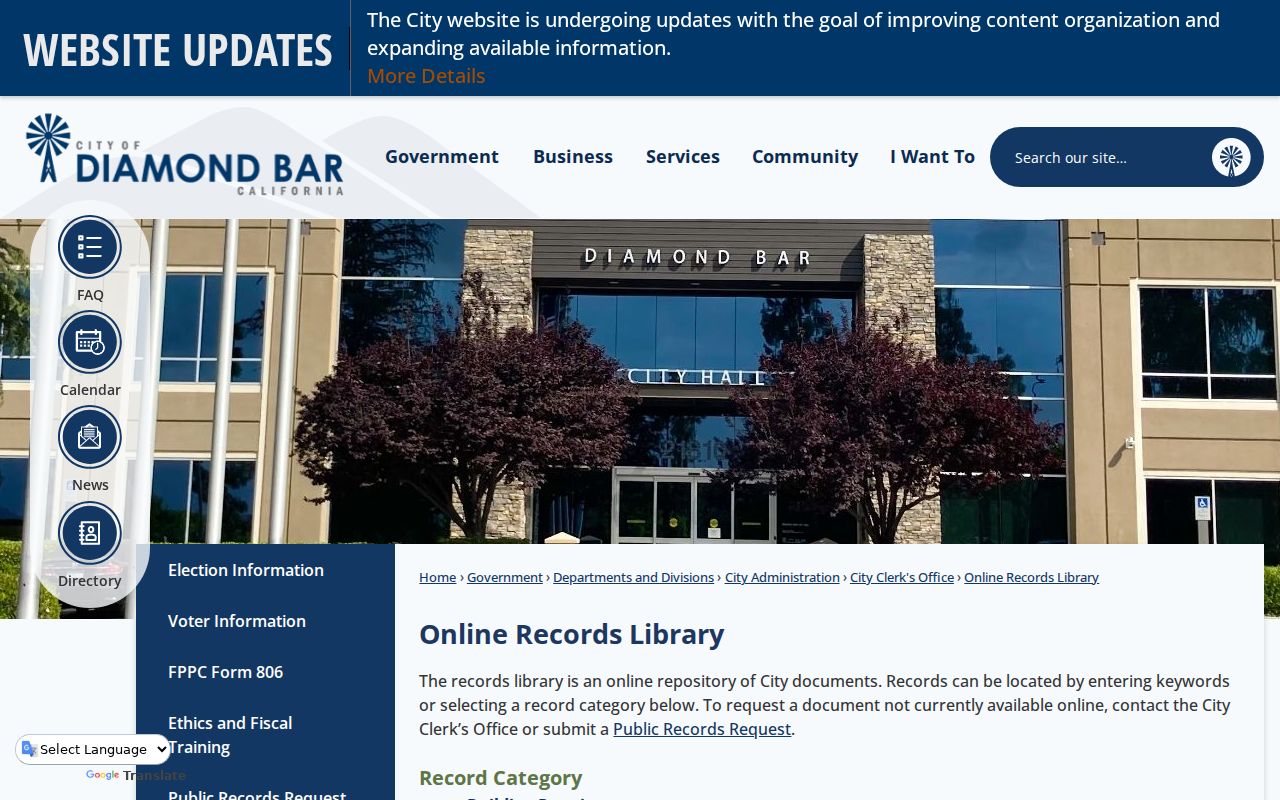
The online library adds city context to the county rolls. It does not replace the RR/CC, the Assessor, or Superior Court as custodians.
Diamond Bar Resident Parcel Search
The Los Angeles County Assessor anchors a Diamond Bar address. Its public interface offers Basic Search, Legal Search, and Map Search. The main route takes an AIN or an address. AIN stands for Assessor Identification Number, a parcel identifier usually shown with hyphens. Results are rich. A situs address ties to the legal description, use, land and improvement values, building facts, map geometry, and roll year.
| Portal control | Type | Required | What it does |
|---|---|---|---|
| Basic Search | Tab or button | No | Starts a current property lookup |
| Legal Search | Tab or button | No | Uses the legal-description route |
| Search by AIN or Address | Text or autocomplete | Yes | Accepts an AIN or standardized situs address |
| Map Search | Interactive map | No | Pans, zooms, and selects a parcel |
| Results and map | Linked panel | After search | Shows parcel facts and the effective-record date |
The assessor screen is an address tool, not a resident directory. Owner names and mailing details are access-sensitive. A mailing address can differ from the parcel, so compare the city Property Parcel Viewer with the county result for boundary, zoning, and ownership. Then save the situs address and legal description. Deeds come next.
The official Assessor Portal belongs to the county. Its AIN-or-address design shows why an address-first search beats guessing a person name.
A parcel result narrows the trail. It cannot show that the owner occupies the home or name everyone who uses it.
The Offline Norwalk Deed Index
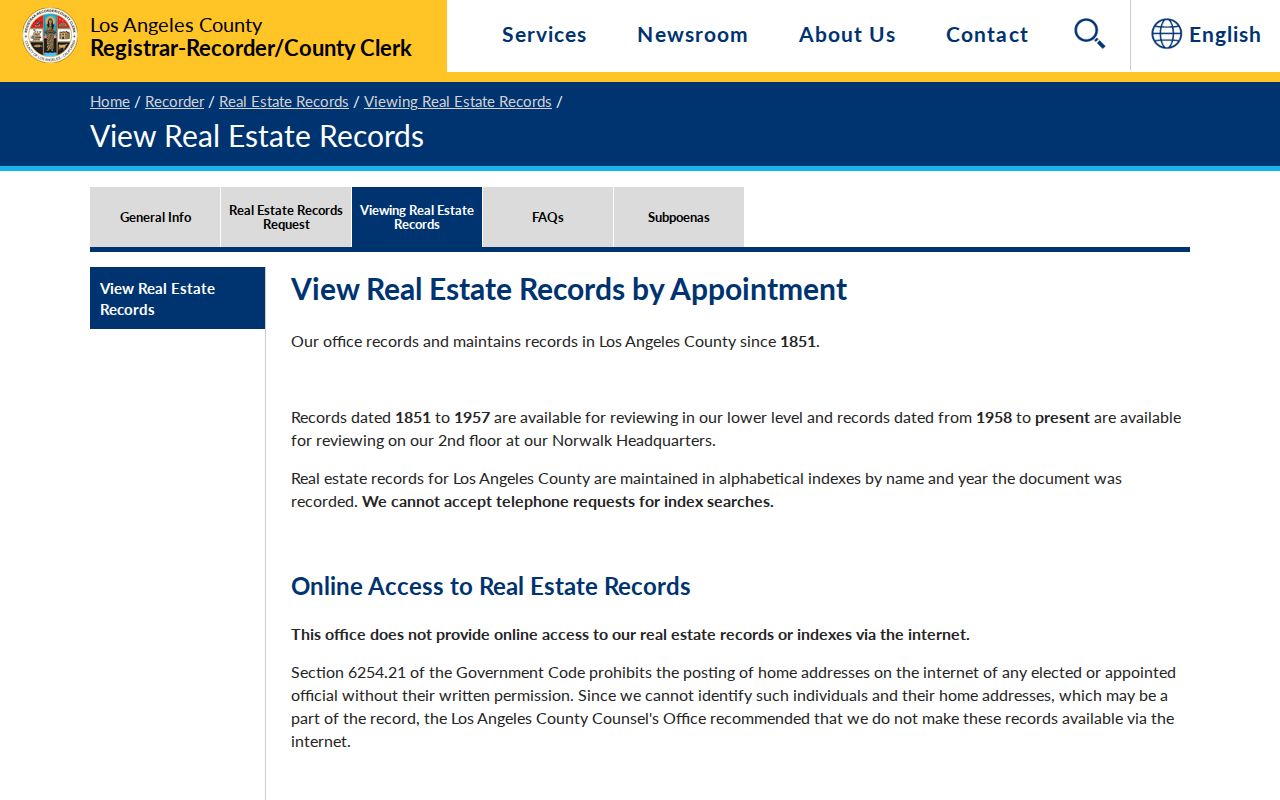
The deed index is the biggest local quirk. It affects anyone building a Diamond Bar residents directory. Los Angeles County keeps its full grantor-grantee index off the internet. County Counsel worried that an online version could expose protected officials' home addresses. So the index stays at the Norwalk records office. Older records, 1851 through 1957, sit downstairs. Everything from 1958 onward is on the second floor. The copy-order page lists 1850 as the start. That is a small date conflict worth raising with RR/CC staff before any historical search.
A counter search starts with a party surname. Add a first name or initial. Add the party's role as grantor or grantee, and the recording year. The index may return a document number. It may also give a recording date, title, and, for older entries, book and page. There is no official address search. Telephone index searches are not offered either. Once a document is known, copies can be ordered online, by mail, or in person. Online orders carry a 20-working-day processing window, and the document must be ordered whole rather than by selected pages.
The official RR/CC viewing instructions lay out the counter-only index and what a visitor should bring. The missing web search is part of the method itself. Plan a Norwalk trip around names and years.
Start with the Assessor or the city GIS for a current owner and a deed clue, then walk backward through the Norwalk name-and-year index. A deed names title parties only, not every occupant.
- Grantor and grantee
- The grantor transfers an interest; the grantee receives it.
- Index
- A finding aid that points to a document, not the complete document image.
- Legal description
- The tract, lot, or boundary language that keeps an old parcel tied to the right land.
- Recorded document
- The filed instrument, such as a deed, lien, release, or deed of trust.
- Roll
- An official list or assessment record maintained for a defined public purpose.
- Criss-cross directory
- A historical reverse directory arranged by street and house number.
- Parcel
- A mapped piece of land with its own identifier and legal description.
Current Diamond Bar Directory Sources
No single current directory lists every Diamond Bar household. The smart move is pairing each source with the question it answers. City permit files sort by street first, then address. Business-license reports run monthly from July 2017. The County Assessor and GIS tools carry the parcel layer, and county voter service confirms a person's own registration. A written voter-file request is a separate purpose-limited path, while private HOA and congregation lists are no public substitute.
| Source | People or facts | Keeper | Access |
|---|---|---|---|
| Assessor roll | AIN, situs, legal, value, building facts | Los Angeles County Assessor | Free address or AIN portal |
| Parcel viewer | Boundaries, zoning, displayed ownership | City of Diamond Bar | Free map click |
| Permit archive | Applicants, owners, contractors, work dates | City Building & Safety | Free street and address browse |
| Business-license reports | Businesses and responsible-party clues | City Planning | Monthly PDFs from July 2017 |
| Voter verification | One voter's own status match | Los Angeles County RR/CC | Free four-field self-check |
| Deed index | Recorded ownership parties | Los Angeles County RR/CC | Norwalk index and paid copies |
Access and quality differ too. Official rolls take more steps but name the custodian. Commercial people-finder tools move faster, yet they can merge names or omit the record sitting behind a lead.
| Route | Useful strength | Limit to keep in mind |
|---|---|---|
| City or county official record | Named custodian, date, record type, and correction path | Fields may be narrow, offline, paid, or purpose restricted |
| Library or archive collection | Older directories, newspapers, census, and local context | Coverage and community geography must be checked |
| Commercial compiled lead | May point toward a possible name or address clue | Freshness, matching, source quality, and lawful use vary |
The California Secretary of State's bizfile Online adds entity names, status, formation dates, agents, addresses, and filed statements. It can tie a person to a business role. It cannot prove anyone's home residency. The same caution fits professional-license files and unclaimed-property clues. The business search screen makes the point plainly. It names entities and filings rather than every neighbor, so it belongs beside a Diamond Bar residents directory, not inside one.
Compare the entity address against the city permit evidence before drawing any personal conclusion. Then verify the record with its named custodian.
Diamond Bar Court Records Search
Diamond Bar has no municipal court. State cases sit with the Los Angeles Superior Court. Federal matters go to the Central District of California and PACER. The Superior Court's Find a Case service splits its tools into Case Access, Case Calendar, Case Document Images, party-name searches for civil, family, probate, and small claims matters, and defendant-name searches for criminal matters. A case-number search is the basic public route. Paid name searches can surface candidate case numbers, but a shared surname still needs more anchors.
- Case-number access
- Shows caption, filing date, court location, type, status, hearings, and public register entries.
- Paid name search
- Uses party or defendant name, case family, date range, and courthouse options; purchased results remain available for 24 hours.
- Document images
- Selected civil, probate, and small-claims images may be purchased; criminal and family images are not published through the general image system.
- Counter fallback
- Courthouse kiosks and clerk windows can provide broader access by case number, with retrieval and copy fees.
The public-facing search choices are visible in the official court interface.
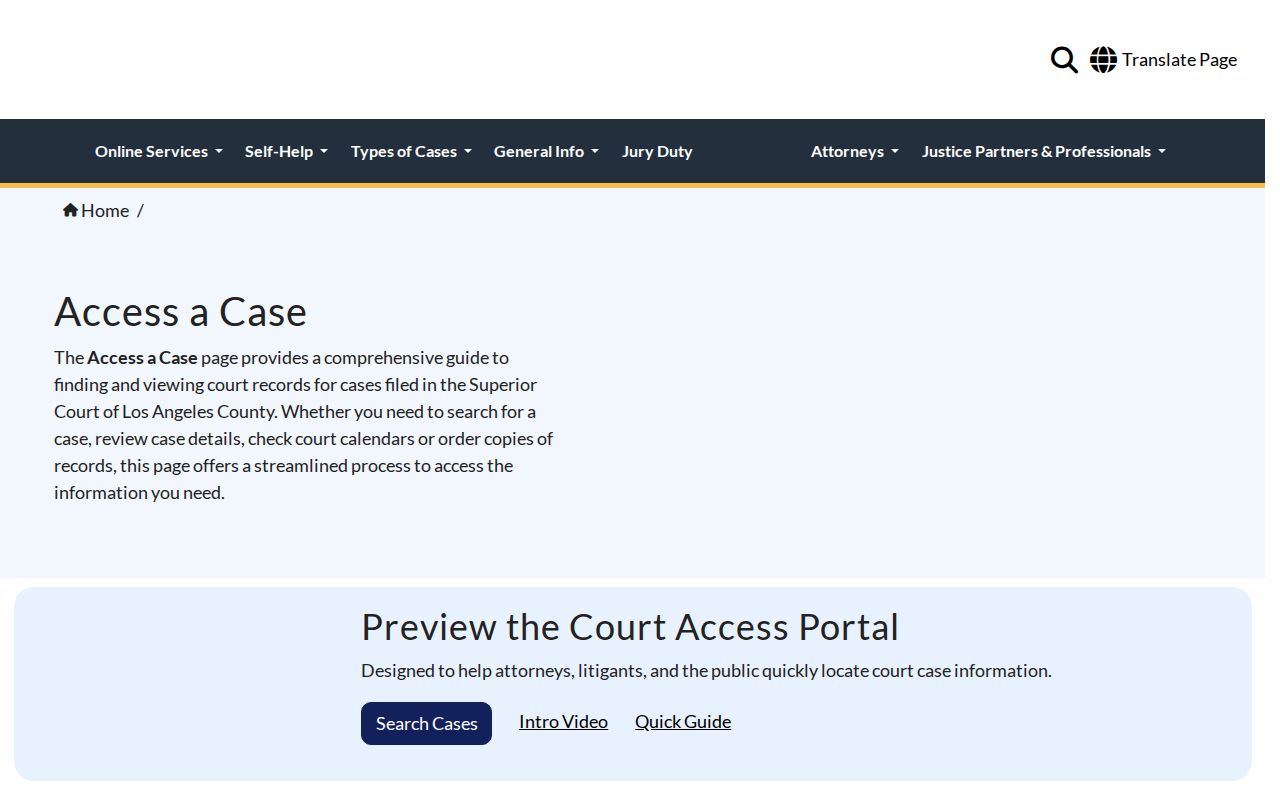
A court result confirms a case relationship or a filing trail. It does not establish residency in Diamond Bar today.
Diamond Bar Voter Verification
The county voter tool is deliberately narrow. Four values are required. They are Last Name, Birthdate, Residence House Number, and ZIP Code. It confirms a voter's own registration and election information. It is not a name-and-street browser for the Diamond Bar residents directory. The wider voter file opens only by written application for an approved purpose, under Elections Code sections 2188, 2188.5, and 2194 and related California regulations. The official verification form shows exactly what the four-field match requires.
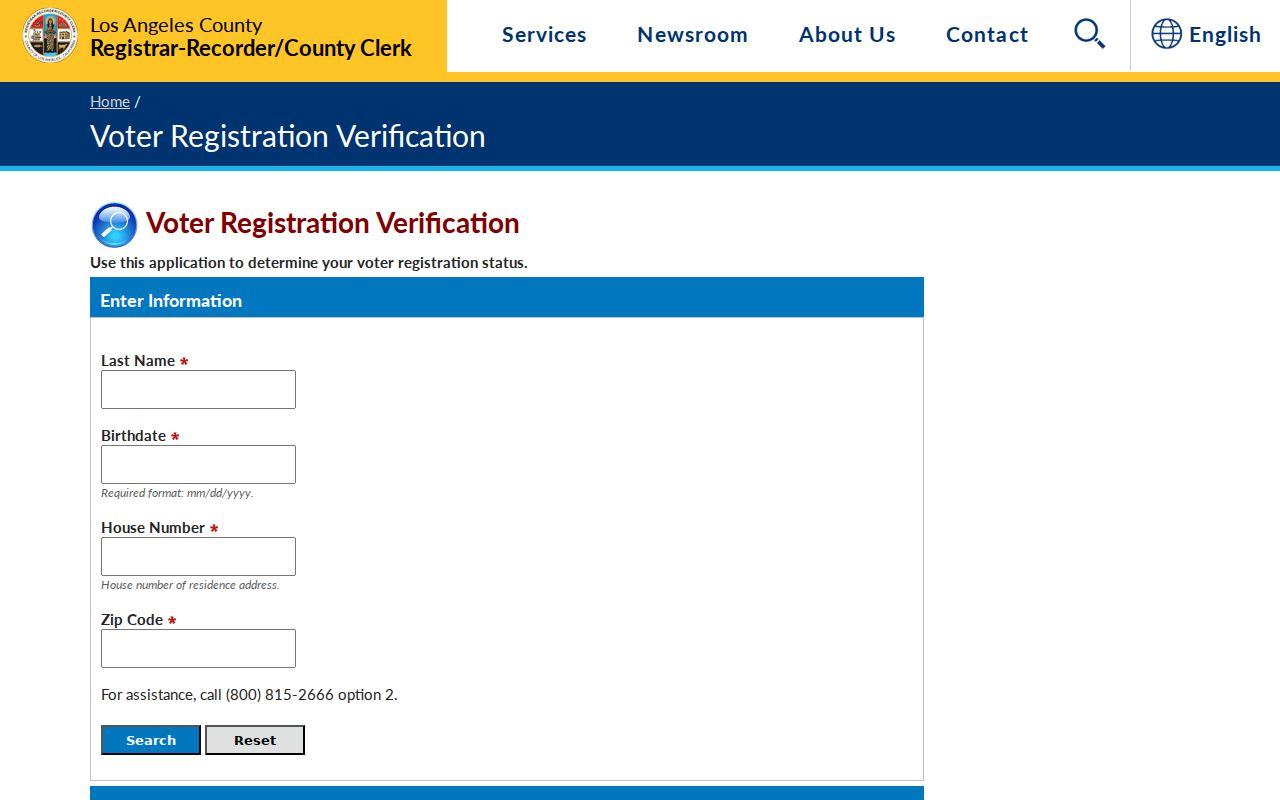
Qualifying data requests start in Norwalk. The County Election Information Section's application asks for the requester, purpose, jurisdictions, file type, media, election or history fields, and processing details. The county help line is (800) 815-2666, option 2. Voter data may never be used for private solicitation or harassment, and confidential voters stay protected.
Diamond Bar Vital Record Routes
Birth, death, and marriage records for Diamond Bar sit with the county and state, not the city. Los Angeles County RR/CC keeps county births since 1866 along with county death and marriage records. The California Department of Public Health supplies statewide applications. Current-year and one-prior-year births and deaths may also be available from the local registrar. Divorce decrees come from Los Angeles Superior Court. CDPH's dissolution certificate carries less record information.
Eligibility matters more than a ZIP code search. Authorized certified copies are limited to statutory persons. Other requesters can generally seek informational certified copies of ordinary birth, death, and public-marriage records. Confidential marriage records open only to a spouse or by court order under Family Code sections 509 through 511. Adoption files and original birth records stay confidential. Applications run online, in person, or by mail, and the state retains the search fee even when no record is found.
- County birth copy
- The 2026 county listing gives a $34 base fee and a 20-business-day processing statement, plus any VitalChek handling.
- State birth application
- CDPH lists $31 for VS 111 in 2026, with authorized or informational copy choices.
- Marriage record
- Public marriage follows the county of license; confidential marriage needs spouse eligibility or a court order.
- Mail request
- Applications need record facts, requester details, copy type, payment, and a sworn statement or notarization when the instructions require it.
Skip the hunt for a Diamond Bar-only vital index. Birth, death, and marriage records flow through state and county channels, so start with the California vital-record forms and the county record page.
Diamond Bar's Ranch-to-Home Record Trail
A resident search in Diamond Bar has to respect the city's strange paper trail. Rancho Los Nogales began with an 1840 Mexican land grant. From there the land passed through Ricardo Vejar, then Louis Phillips. Later came the Lewis and Bartholome families, and the Diamond Bar ranch era. Transamerica bought 8,000 acres in 1956. Northern model homes followed in 1960. The city itself incorporated on April 18, 1989. So a modern street address may mean nothing at all in a nineteenth-century source.
- For land before the city, search the legal description, ranch name, Spadra, Walnut Valley, or Pomona vicinity.
- For the development era, pair subdivision deeds and permits with the first model-home and tract evidence.
- For post-incorporation civic records, search City Council, commission, and History Project material.
- For a household, keep title owners, permit participants, and enumerated residents in separate evidence columns.
The city history chronology explains why a directory hit under a neighboring place name still counts. But "Spadra" is not a synonym for every modern Diamond Bar parcel.
Diamond Bar ZIP Geography
Most Diamond Bar addresses carry ZIP Code 91765. Postal geography and city limits, though, are different systems. About 3,000 residents and businesses sat on the city's northern or western edge historically. They used Walnut ZIP 91789. In October 2011 the city promoted a USPS survey. It was meant to pull those addresses into 91765. The distinction matters for any directory, newspaper, license, or old form. Some of these list Walnut as the postal identity. Verify each address in USPS ZIP Lookup. Do not read a ZIP off a map radius. City GIS decides whether a parcel sits inside the incorporated boundary. USPS handles delivery routing. Los Angeles County defines the parcel and tax geography. Walnut Valley Unified and Pomona Unified set school-service geography. A Diamond Bar residents directory reads far more clearly when those lines sit side by side. It should not collapse them into one boundary.
Historical Diamond Bar Directories
The Los Angeles Public Library has digitized Los Angeles-area city and street-address directories. The years span 1875 to 1987. ResCarta metadata lists historic city, business, and phone directories from 1873 to 1970. It also lists reverse directories in 1906, 1927, and 1956 through 1987. None of those labels guarantees Diamond Bar coverage. Check the publication front matter, the community list, and the page image. Do that before counting a name as a local hit. Entries may carry a name, spouse, occupation, an "h" householder mark, and an "r" resident mark, and a street address. Keep in mind that omission never proves a person was absent. The full collection method lives on the Diamond Bar city directory page. For a quick start, search historic place names and spelling variants. Also remember that reverse volumes may render an address as "Ave 64" or "Avenue Sixty-Four."
Diamond Bar Historical Archive Trail
The Diamond Bar Library handles research questions in person and by phone. It offers catalog and database access, newspapers, and Chinese-language holdings. The branch opened in 1977 and moved to the City Hall site in 2012. Staff can also route a question to the County Californiana Collection. That collection sits in closed stacks at Norwalk Library. It holds nineteenth-century directories, California census schedules from 1850 through 1910, newspapers, and official histories. Call before traveling, since the online description publishes no dedicated Diamond Bar directory run. Deeper family research opens other doors. The California State Archives catalogs genealogy holdings. NARA Riverside keeps Los Angeles naturalization indexes and petitions. A narrow CPRA request works as a fallback for a missing city file. Name the address or APN, a date range, the record category, and your preferred electronic format. The city's form carries no submission fee, though physical duplication can be charged. The city's official records-request route shows that local fallback. It appears whenever a search box fails to return a needed file.
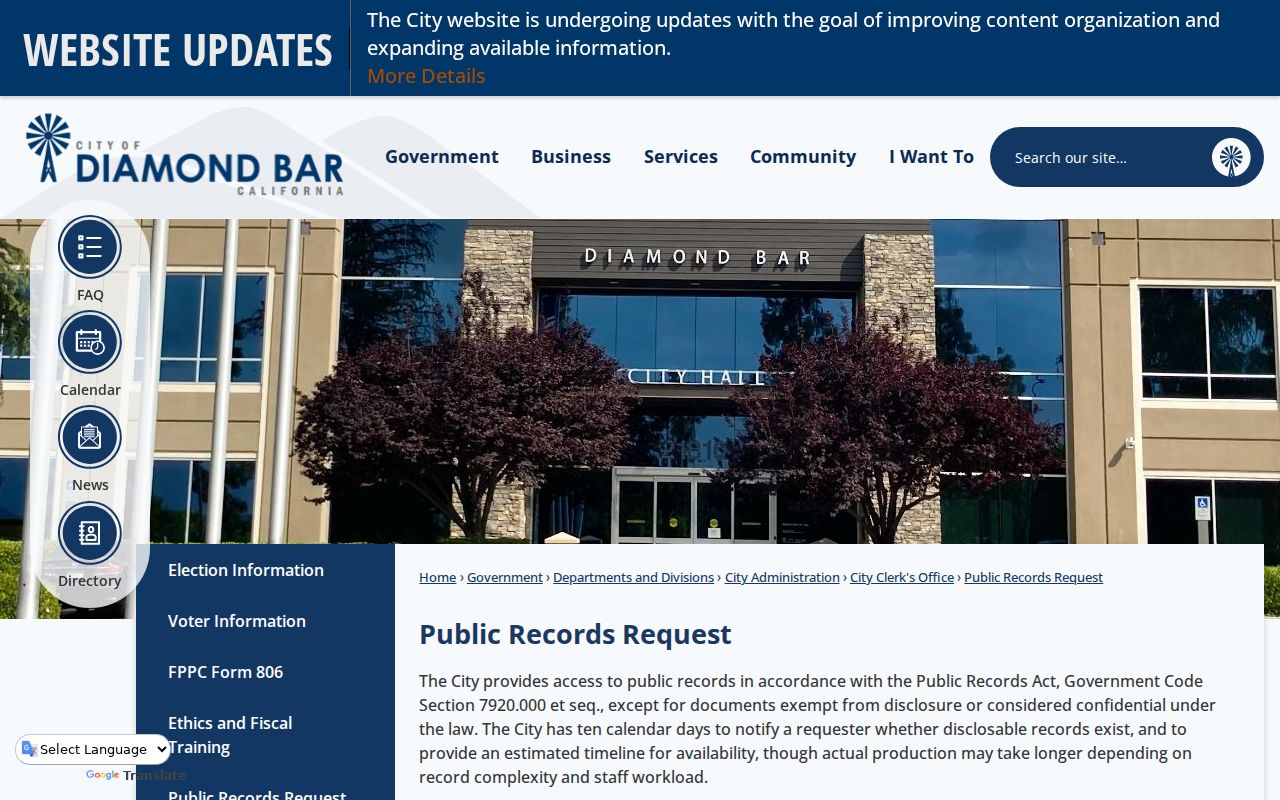
A request should name the custodian and the record, not ask an office to build a new resident list.
Diamond Bar Address Privacy Rules
California's Safe at Home program gives eligible survivors a substitute mailing address with mail forwarding. Threatened covered workers qualify too. Government Code sections 6205 and following govern it. Qualifying participants can request special handling for certain deeds and change-of-ownership filings. A substitute address, though, is not an identity change. A legal description may still reveal where property sits. Recorded documents generally cannot be erased through a simple opt-out request. A court order is a separate process.
Lawful personal use. Public records support family history, property research, civic review, and personal safety. Do not use a Diamond Bar resident record to stalk, harass, threaten, or harm anyone, and verify sensitive facts with the custodian before acting.
No complete residents directory can be assembled from public sources, and California's voter-data restrictions, the federal Driver's Privacy Protection Act, and confidential records rules explain why. A missing name may reflect a protected program, a closed record, a different postal identity, or a plain coverage gap.
Recent Diamond Bar Records Changes
Records access keeps shifting in California. The state's 2026 Delete Request and Opt-out Platform, called DROP, is one example. A resident can send a single encrypted deletion or no-sale request to more than 500 registered data brokers. Processing duties start August 1, 2026. DROP targets commercial data exposure, though. It does not remove a lawful county deed or a court file.
Closer to home, Los Angeles Superior Court rebuilt its website in 2025 after the 2024 ransomware disruption. Expanded courthouse kiosks now open more records to the public. The county's Homeowner Notification Program adds another layer. It mails copies of qualifying ownership, loan, default, or sale documents, with optional email notice through an Assessor portal profile. Always confirm any notice or fee on an official .gov or .ca.gov address.
Shifts like these sharpen the Diamond Bar residents directory. Each result gains value when it carries a date, a source link, a record type, and a custodian. Verification becomes a standing habit of the search, not a final afterthought.