
What a Diamond Bar Resident Lookup Confirms
The first question is what kind of fact is needed. A parcel result can connect an address to an AIN and title clue. A court index can identify a party and case number. A vital record can confirm an event if the requester qualifies for that copy class. A business filing shows an entity role. A license result shows a professional record. None of these is a complete statement of current residence.
| Record | What it confirms | Where | Access |
|---|---|---|---|
| Assessor or GIS | Title-owner and address or APN relationship | County and city portals | Free address, AIN, or map search |
| Recorded deed | Named party and recorded ownership instrument | RR/CC Norwalk | Name/year index; known-document copies |
| Voter self-lookup | One voter's own registration match and status | Los Angeles County | Four private matching fields |
| Superior Court index | Party or defendant and case number | Los Angeles Superior Court | Case number free; name search fee |
| Vital record | Birth, death, marriage, or dissolution event | RR/CC or CDPH | Copy class, eligibility, and fee rules |
| Business or license file | Entity role, license status, or public business address | City, SOS, DCA, CSLB | Free public search; board limits vary |
| Unclaimed property | Name plus reported city or ZIP clue | California State Controller | Free search; claim proof required |
A careful resident lookup states the source and its limit beside every match. A name alone is not an identity anchor.
Cross-Checking a Diamond Bar Lookup
Diamond Bar has more than 52,000 residents, a large Asian population, and names that may appear in different given-name order, spacing, hyphenation, or romanization. Preserve the exact spelling, middle initial, alias, and name order. Search a plausible reversed or shortened form, but do not merge two people because they share a surname and city. The right-person method needs at least two independent anchors.
- Write the name as shown, including middle names, initials, punctuation, and any spouse or business association.
- Find a candidate address or parcel through GIS or the Assessor, then save the APN, legal description, and situs address.
- Test the same name in the Superior Court index, SOS bizfile, DCA or CSLB license search, or an obituary, depending on the purpose.
- Compare dates, roles, spouse, entity, case, or APN. A second source must agree on a fact that is not just the name.
- Ask the custodian for a certified copy or correction route when the result matters.
For a former classmate, library yearbooks and historical directories may be the better lead. For an heir, probate and distribution deeds are stronger. For a current address question, a parcel result is still ownership evidence, not occupancy proof.
Diamond Bar Resident Lookup Court Records
Los Angeles Superior Court has no single “resident” field. Its Find a Case service offers Case Access by case number, Case Calendar, Case Document Images, party-name searches for civil, family, probate, and small claims cases, and defendant-name searches for criminal cases. The paid party search uses name, date range, case type, and courthouse or district choices that vary by case family. Criminal narrowing may ask for a birthdate. A name result is a candidate list, not a final identity match.
| Case number | Required for Case Access and Calendar; identifies the exact file and court events. |
|---|---|
| Party or defendant name | Last name, first name, middle initial, and case-family fields; date range or courthouse can narrow the set. |
| Result access | Purchased name results remain available for 24 hours; purchased documents remain available for 30 days. |
| Images and exclusions | Selected civil, probate, and small-claims images may be available; criminal and family images are not in the general online image system. |
The official Los Angeles Superior Court case page is the proper starting point.
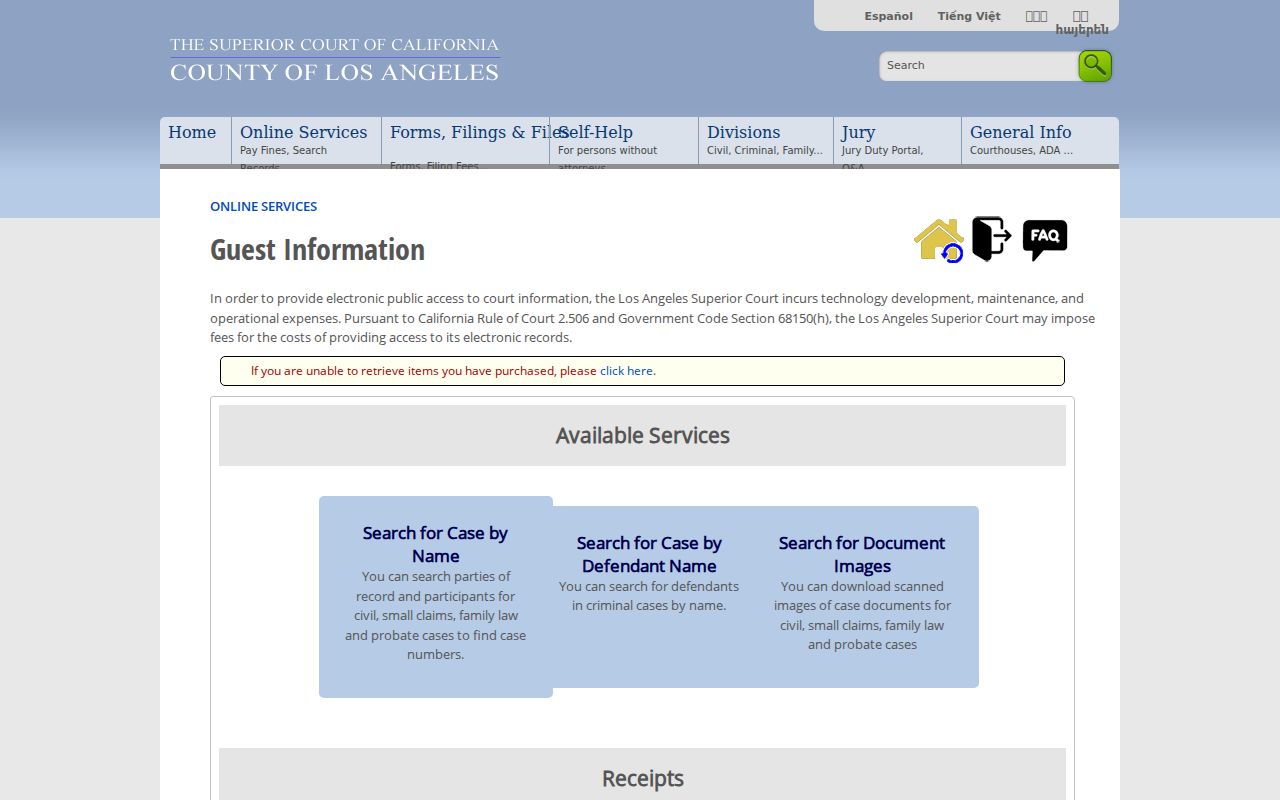
The court interface shows why case number, court, and filing date are better anchors than a name alone.
Reading a Diamond Bar Court Record
A public case result has a small but useful inventory. It can show the caption, party roles, case number, filing date, courthouse or district, case type and status, judge or judicial officer, future hearings, register-of-actions entries, and a public disposition or judgment when available. A selected document image may add a petition, order, or filing detail, while juvenile, adoption, sealed, expunged, and sensitive records remain restricted. A missing online result is not proof that no file exists.
- Identity: caption and plaintiff, petitioner, defendant, respondent, decedent, or participant role.
- Placement: case number, filing court, filing date, department, and assigned judicial officer.
- Substance: case type, status, hearings, register entries, disposition, or judgment.
- Images: selected public civil, probate, or small-claims documents, subject to purchase and redaction.
- Fallback: courthouse kiosk, clerk window, or file retrieval by case number.
- Docket
- The case's running record of filings, events, hearings, and orders.
- Index versus image
- An index points to a case; an image is a copy of a filed document.
- Certified copy
- A clerk-authenticated copy requested under the court's copy rules.
- Disposition
- The recorded outcome or status of a case, when public.
Federal matters use PACER and the Central District of California. Federal search is a separate channel with account and page-fee rules.
Diamond Bar Resident Lookup Property Records
The County Assessor and city GIS can anchor a Diamond Bar name to a parcel, but the match remains an ownership or mailing clue. A situs address is the physical parcel. A mailing address is where tax correspondence goes. The legal description is the tract and lot language. A different mailing address may suggest that the owner lives elsewhere, but it does not establish who occupies the home.
The current-owner workflow is address to GIS or Assessor, then APN or title clue, then a known deed or the Norwalk index. The recorder's grantor-grantee record shows title parties, not renters, relatives, guests, or every household member. A permit applicant or contractor is likewise a transaction role. The distinction is central to responsible name verification.
The city parcel viewer and the Assessor Portal should be read together, then checked against the recorded document when available.
Diamond Bar Resident Lookup Business Trails
A person can be easier to confirm through an official role than through a household record. Diamond Bar business-license reports run monthly from July 2017 and can show a business, responsible party, contact, and business address. The Secretary of State's bizfile search adds entity name or number, status, formation date, jurisdiction, agent for service, principal or mailing address, and filed statements. These affiliations support identity cross-checking, but they do not prove a home address.
California Department of Consumer Affairs advanced search accepts first and last name, license number, business name, registry number, board or bureau, license type, city or county, status, disciplinary action, and public documents. CSLB has modes for license number, contractor business name, personnel name, salesperson registration, and city or ZIP with classification. Result limits apply.
The CSLB interface demonstrates an official role search that can support a person check without pretending to be a household roll.
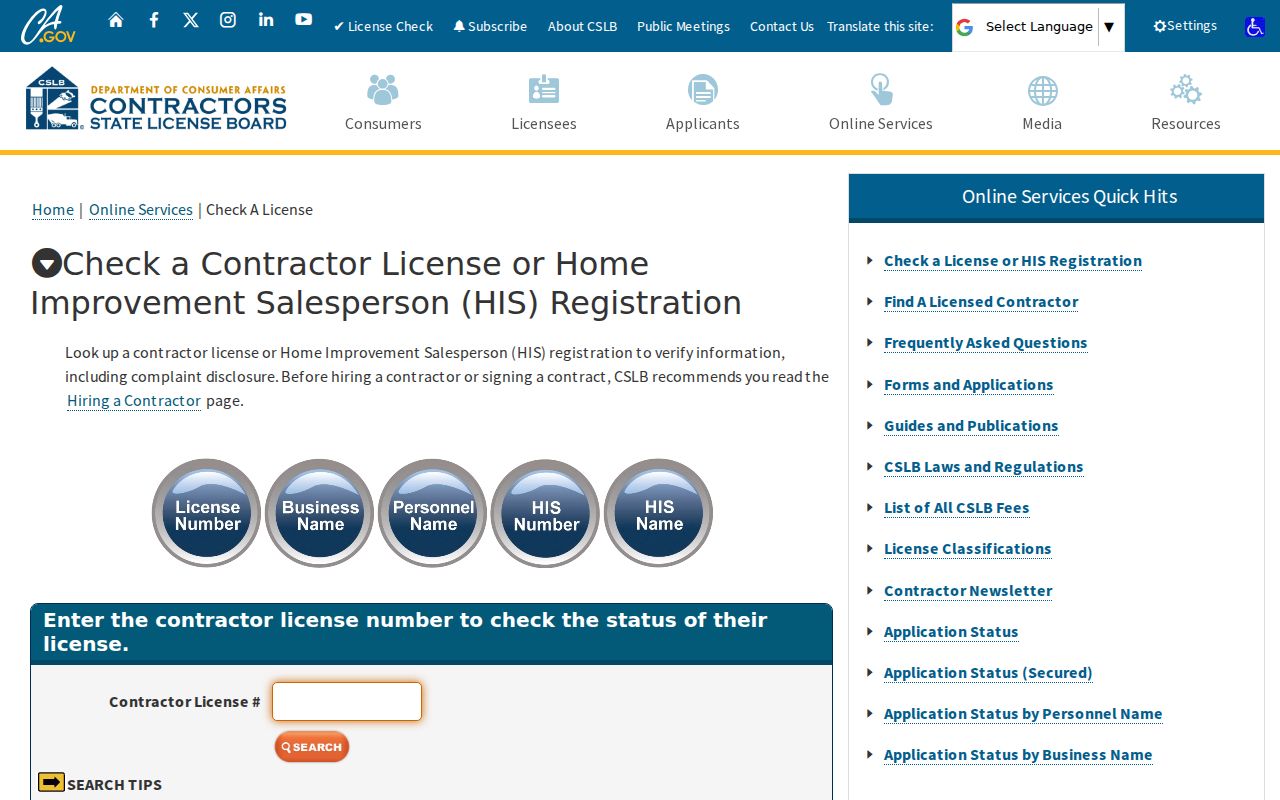
Compare license number, business, city, status, and public documents before treating a professional record as belonging to the right person.
Diamond Bar Probate Heirs and Vital Records
An heir search starts with an event, not an address. Los Angeles Superior Court probate petitions may name a decedent, petitioner, heirs, and mailing addresses, subject to redaction. A recorded distribution deed can then connect an estate to land. An obituary and newspaper notice can fill family context. This is a useful human trail because each source has a different role and error profile.
County births begin in 1866. For 2026, county and state base fees differ: the county page lists $34 for an authorized county birth copy, while CDPH lists $31 for a state VS 111 birth application, $26 for death, $19 for marriage, and $18 for a dissolution certificate. Informational certified copies are generally available for ordinary birth, death, and public-marriage records, while authorized copies need statutory eligibility. Confidential marriage records require a spouse or court order. Adoption and original birth records are confidential.
For a birth parent, California's official adoption information and consent routes replace a public name search. For a former classmate, yearbooks and the local library are safer leads. Obtain a certified or informational copy through CDPH forms or the county birth-order route when eligible.
Diamond Bar Resident Lookup Fallbacks
Official access has layers. A failed web result can mean the record is at a counter, behind a paid name search, in a closed stack, covered by a different office, or protected by law. Los Angeles Superior Court offers kiosks and clerk windows. RR/CC has the Norwalk index and mail or in-person copy paths. The Diamond Bar City Clerk accepts a CPRA request for municipal records, and library reference staff can search directory, newspaper, and Californiana holdings.
A useful written request names the department, address or APN, date range, record category, known spelling, and preferred format. CPRA generally gives an agency 10 calendar days to determine whether responsive disclosable records exist, though unusual circumstances can extend the determination. The Act does not require an agency to create a new list or answer a research question.
California State Archives and NARA Riverside can help with older genealogy or naturalization series. The state and county offices, not a third-party result, are the place to correct or certify a record.
Diamond Bar Resident Lookup Privacy
Safe at Home can give eligible survivors and threatened covered workers a substitute mailing address and forwarding service. Voter data is purpose restricted, confidential voters receive protection, and California's CCPA rights do not erase lawful government records. California's 2026 DROP platform can send one deletion or no-sale request to more than 500 registered data brokers, but it does not remove a county deed or court file.
Lawful personal use. Use this name search for family history, reconnecting, estate research, civic review, or personal safety. Do not use a record to stalk, harass, threaten, intimidate, or harm anyone.
Check the custodian's date, source, and access note before relying on a result. A protected address, closed court file, private voter match, or missing directory entry is a limit to respect, not an invitation to find a back door.
For a block or whole-street question, move to the Diamond Bar street directory and keep the work address-based.